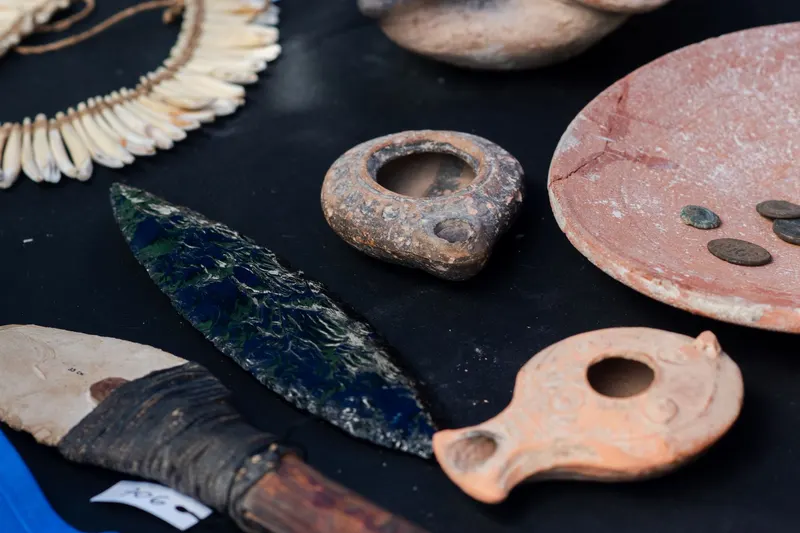
A hominin (a member of the human lineage, including extinct species) living in eastern Africa millions of years ago had teeth and hands poorly suited to cutting the hide of a large animal, cracking bones to reach marrow, or prying apart tough roots. It had no claws and no carnivore's fangs. One solution that spread was to produce artificial cutting edges by striking one stone against another. This apparently simple step opened up new sources of food and is the earliest starting point of the history of technology.
How a stone tool was made
The basic technique is percussion flaking. The maker holds a stone of good quality, the core, and strikes it with another stone, the hammerstone, at a carefully chosen angle. Fine-grained rocks that fracture predictably, such as flint, quartzite, basalt, and obsidian, break into flakes with very sharp edges in a pattern called conchoidal fracture, named for the shell-like ripples it leaves. Both the flakes and the core can serve as tools.
Doing this well takes knowledge of the material, a sense of angles, and controlled force. Modern experiments in which researchers learn to knap stone show that the skill takes time to master, which suggests that it was passed on by watching and imitating other members of the group.
Over time, further techniques appeared. Retouch removes small flakes along an edge to sharpen or shape it. Soft hammers of bone, antler, or wood allow finer control. Much later, pressure flaking with a pointed tool made it possible to detach thin blades and delicate points.
A chronology in debate
The oldest evidence for stone tools comes from Africa. In 2015, a team led by Sonia Harmand reported in Nature a set of artifacts from Lomekwi 3, in the West Turkana region of Kenya, dated to about 3.3 million years ago. If the dating and interpretation hold, they predate the genus Homo. Researchers still discuss whether some of the pieces were produced intentionally and how the assemblage should be classified, so it is best treated as an important and still contested find.
The oldest tools accepted more widely come from Gona, in Ethiopia, and are about 2.6 million years old. The simple toolmaking tradition of that period is called the Oldowan (or Mode 1), after Olduvai Gorge in Tanzania, where Louis and Mary Leakey studied such artifacts in the mid-twentieth century. It includes cores, flakes, and hammerstones without highly standardized shapes.
A second major tradition is the Acheulean (Mode 2), which appears in African sites from roughly 1.7 million years ago. Its emblem is the handaxe, a tool worked on both faces, often teardrop or almond shaped. Handaxes were made for well over a million years across Africa, Europe, and Asia. In some assemblages the symmetry and finish suggest a mental template of form, though scholars still argue over whether handaxes were mainly cutting tools, carried social signals, or both.
These tools were not made by our species. They are much older than Homo sapiens, whose earliest known fossils are dated to around 300,000 years ago, and they were produced by several kinds of hominins. The temptation to credit a single "inventor" species does not match what the record shows.
Function is another point of caution. A sharp flake may have cut meat, scraped hides, worked wood, or cut plants. Only microscopic study of edge wear and residues trapped on the edge can suggest what a given piece was used for. Archaeologists therefore avoid inferring a group's way of life from one class of object, and they try to combine tools with animal bones, sediments, and traces of occupation.
Fire, wood, and other materials
The control of fire is another subject with disputed dates. There are signs of fire use at Wonderwerk Cave in South Africa, where a 2012 study identified burned bone and ashed plant remains in layers about 1 million years old, and at Gesher Benot Ya'aqov in Israel, where burned seeds, wood, and flint were reported in layers roughly 780,000 to 790,000 years old. The hard question is telling natural fire that people took advantage of from fire that was made and kept habitually. Evidence for habitual use becomes more abundant in later periods, and researchers disagree about when it became general. Fire allowed cooking, discouraged predators, hardened wood, and extended social time after dark, but the relative importance of each effect is debated.
Organic materials survive only rarely, which makes some finds precious. At Schöningen, in Germany, wooden throwing spears were found alongside the remains of butchered horses. They were long dated to about 300,000 years ago, but a study published in Science Advances in 2025, which measured amino acids in the shells of small freshwater snails from the site, argued for a younger age of roughly 200,000 years and attributed the hunters to Neanderthals. Either way, the spears point to planned hunting with well-designed weapons. At Kalambo Falls, in Zambia, a 2023 study in Nature used luminescence dating to place two logs joined by a deliberately cut notch at least 476,000 years ago (with an uncertainty of about 23,000 years). The authors interpreted them as part of the foundation of a platform or similar structure, though what the logs formed remains under discussion. The same waterlogged deposits also yielded wooden tools, including a wedge and a digging stick, from a later phase of roughly 390,000 to 324,000 years ago. These finds show that wood was worked far earlier than stone alone would suggest.
In more recent parts of the Paleolithic there is evidence of tools in bone and antler, such as awls and eyed needles, and of fragments of twisted fiber cord. Dating depends on the site. Bone needles are documented in several regions from roughly 50,000 to 40,000 years ago (an eyed needle from Denisova Cave in Siberia is dated by its excavators to about 50,000 years ago), and cordage appears in both Neanderthal and modern human contexts. Sewing, nets, baskets, and traps depend on these techniques, and most of them left almost no trace.
Impact and limitations of the interpretation
Tools widened the diet: sharp flakes let people remove meat from carcasses, and hammerstones opened bones. Later, spears and traps made larger prey accessible. Many researchers link toolmaking to changes in cognition, cooperation, and social learning, but the direction of cause is uncertain. It cannot be said that technique "produced" larger brains or the reverse. The prudent term is coevolution, a process in which biology, behavior, and culture influence one another.
The greatest interpretive hazard is preservation bias. Stone survives for millions of years, while wood, fiber, leather, and small bones usually disappear. This is why prehistory is often called the "Stone Age," a label that reflects what endures rather than necessarily what people used most. There is also a geographic bias: eastern Africa has been studied intensely, and sites in other regions may have been less explored. Dates change as new dating methods and new excavations are applied, so every figure should be read as an estimate.
Connections to other technologies
The same knapping and grinding techniques lead to sickle blades and grindstones used in agriculture and storage, and accumulated knowledge about fire, clay, and minerals prepared the ground for metallurgy. The oldest tools also put in perspective the general question explored in What Technology Is and How Its History Can Be Studied: technique and knowledge existed long before any machine, and the archaeological record preserves only part of them.