For tens of thousands of years, toolmakers worked with whatever nature supplied ready-made: stone, bone, wood, fiber. Stone chips and dulls, bone snaps, and wood rots. A broken flint axe is finished, but a broken metal one can be melted down and cast again. Metals offered something no earlier material did, which was the ability to be reused, reshaped and, with the right recipe, hardened.
The first metals people used were those that occur in pure form, such as native copper and gold. They were hammered cold, much as if they were a malleable kind of stone. Metallurgy in the strict sense began when people learned to smelt metal, meaning to extract it from ores (rocks in which the metal is chemically combined with other elements), and to alloy it, mixing it with other metals to change its properties.
How it works
Smelting and casting
Smelting rests on a chemical idea that ancient workers used long before anyone could explain it. When an ore is heated together with charcoal, the burning charcoal produces carbon monoxide, which strips oxygen away from the metal compound. Chemists call this reduction. For copper, green ores such as malachite were crushed and heated in a crucible or a small furnace with charcoal. The temperature had to stay above about 1,100 degrees Celsius (roughly 2,000 degrees Fahrenheit) for copper to melt, which is why bellows, clay blowpipes and furnaces with draft openings mattered as much as the ore itself.
Molten copper can be poured into molds. Open molds of stone or clay make flat axes and blades; two-part molds make more complex shapes. A more sophisticated method is lost-wax casting: the maker models an object in wax, covers it with clay, heats the clay so the wax runs out, and pours metal into the empty space. The mold is broken to free the piece, so each casting is unique. Among the earliest known examples of the technique are the copper objects of the Nahal Mishmar hoard, found in a cave in the Judean Desert and assigned to the Chalcolithic period, roughly 3500 BCE (radiocarbon dating of the reed mat that wrapped the objects points to at least that age). Variants later appear in the Near East, Egypt, China, West Africa and the Andes.
Alloys and bronze
Pure copper is fairly soft. Early smiths discovered that adding other elements helped. The first widespread alloys used arsenic, which was probably present in some ores to begin with. Later came bronze, copper with tin. Tin bronze is harder, melts at a lower temperature and flows better into molds. Archaeologists generally place its regular use in the Near East and neighboring regions by about 3000 BCE, with considerable local variation and some earlier claims that remain disputed. It became common across the third and second millennia BCE.
Tin is scarce, and its deposits lie far from many of the places that wanted it. That produced long-distance trade, documented in Mesopotamian texts and in shipwrecks. The best known is the Uluburun wreck off the southern coast of Turkey, dated to about 1320 BCE, in the late fourteenth century, which carried roughly ten tons of copper ingots and about a ton of tin, along with glass, ivory and other goods. Isotope analysis published in 2022 traced about two-thirds of the tin to sources in Turkey and about one-third to Central Asia. A craft that depended on a few distant sources made access to metal a political and economic matter.
Iron and steel
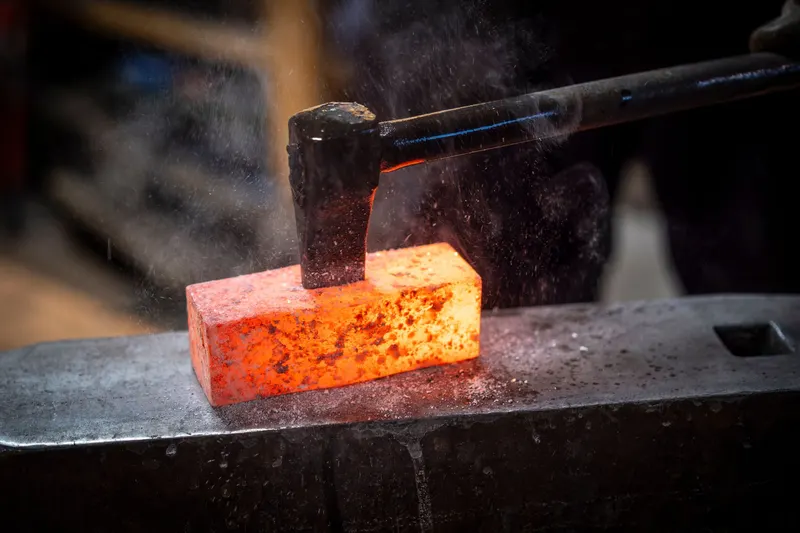
Iron behaves differently. Its ores are abundant, but early furnaces could not reach the roughly 1,540 degrees Celsius (2,800 degrees Fahrenheit) needed to melt pure iron. In a bloomery furnace, the ore was reduced at lower temperatures and the result was a spongy lump of iron mixed with slag (glassy waste), called a bloom. The smith then reheated and hammered the bloom to squeeze out impurities and weld it into solid metal. This is forging, and the blacksmith's trade grew out of it.
Steel is iron with a small amount of carbon. With the right carbon content and the right heat treatment, it can be made hard without becoming brittle. In quenching, a piece is heated and then cooled rapidly in water or oil. Ancient smiths judged these steps by the color of the glowing metal and by experience, without any knowledge of the underlying chemistry.
Historical context
The earliest evidence of copper smelting comes from southeastern Europe. Sites of the Vinča culture, including Belovode and Pločnik in present-day Serbia, have produced copper slag and objects that researchers date to roughly the fifth millennium BCE; a 2010 study put the smelting debris at Belovode at about 5000 BCE. Whether smelting began there independently, or in the Near East or on the Iranian Plateau, is still argued, and radiocarbon results can shift dates. Most specialists now speak of several centers of innovation and of exchanges of knowledge that are not fully understood.
Iron also predates the Iron Age. Objects of meteoritic iron, rich in nickel, were worked in Egypt and elsewhere long before anyone could reduce iron ore. Small tube beads from a cemetery at Gerzeh, in Egypt, dated to roughly 3400 to 3100 BCE, were shown in 2013 to be hammered from meteoritic iron, and a 2016 analysis of the iron dagger blade from the tomb of Tutankhamun (14th century BCE) reached the same conclusion. Iron smelted from ore appears sporadically in the second millennium BCE. It came into wide use in Anatolia, the Near East, the Mediterranean and South Asia around 1200 BCE and in the centuries after. The once-popular idea of a Hittite monopoly on iron technology is now treated with skepticism by most researchers.
Africa has its own rich ironworking record. Smelting furnaces have been excavated from the Sahel to central and eastern Africa, with dates at some sites in the first millennium BCE. Whether iron smelting was invented independently in sub-Saharan Africa or arrived through contact with North Africa and the Nile valley remains under debate, and the chronology of individual sites keeps being revised. African smiths developed furnace designs suited to local ores and fuels, including forced-draft and natural-draft types. In South Asia and Sri Lanka, crucible steel known as wootz was made by melting iron with carbon-bearing material in sealed clay pots, and it was traded widely across Eurasia in the first millennium CE and after.
The Americas followed a different path. Andean peoples worked gold, silver and copper, and made alloys such as tumbaga, a mixture of copper and gold, using sophisticated gilding and lost-wax techniques. Gold working in the Andes goes back to about the second millennium BCE, and bronze became important later, notably under Inca rule. Metallurgy reached western Mexico around 600 CE, probably through contact with the Andean region and Ecuador, and there it was used mainly for ornaments and ritual objects. Iron arrived in the Americas only with Europeans.
In China the sequence differed again. Bronze casting reached extraordinary levels in the Shang and Zhou periods, using piece-mold casting rather than lost wax for its great ritual vessels. Cast iron, produced by melting the metal in larger furnaces with stronger bellows, appears there by about the fifth century BCE, many centuries before it became routine in Europe.
Impact and limitations
Metals gave the ancient world axes, adzes and saws that made carpentry and shipbuilding easier, along with weapons, jewelry, vessels and, from about 600 BCE in Lydia in Anatolia, coins. Because iron ore was cheaper and more widely available than tin, iron blades and plowshares eventually reached more people than bronze ever had. In many societies smiths held an ambiguous position: respected for their power to transform matter, but sometimes surrounded by taboos and ritual restrictions.
There were costs as well. Smelting devoured wood for charcoal and put pressure on forests around workshops. Smoke and waste left traces in lake sediments and glaciers; ice cores from Greenland record lead pollution from silver and lead production across European antiquity, with the highest sustained levels in the first two centuries of the Roman Empire. Mining was hard and dangerous and often involved forced labor. The silver mines at Laurion, which supported Athens, relied on enslaved workers. Because ores were unevenly distributed, those who controlled mines and trade routes could accumulate power and wealth.
The technical limits were clear too. Furnace temperature, ore purity and the strength of the bellows set what was possible. Liquid iron was produced only occasionally in early furnaces, so most European iron was wrought iron for centuries. Blast furnaces, tall stacks driven by water-powered bellows that produce molten iron, appear in parts of Europe between roughly the twelfth and fifteenth centuries and spread widely in the later Middle Ages and early modern period. In 1709, Abraham Darby succeeded in smelting iron with coke rather than charcoal at Coalbrookdale in England, a step that eased the wood constraint and mattered for the Industrial Revolution.
Connections to other technologies
Metallurgy drew on the long experience described in the first tools. The early smelters were potters and stoneworkers who already understood fire, clay and rock. Metals then changed the wheel and other rotating mechanisms: axles, rims and gears gained strength from bronze and iron, and wear on moving parts became a problem of alloys and lubrication.
In ancient engineering, iron and bronze appear in construction clamps, nails, masons' tools, pumps and precision mechanisms. Centuries later, the same search for more and better iron underpinned factories and industrialization: coke-fired blast furnaces, rolling mills and, after Henry Bessemer's patent of 1856, mass production of steel changed the scale of what could be built from metal. The steam engine depended on iron cylinders and boilers that could be made to tolerable accuracy.