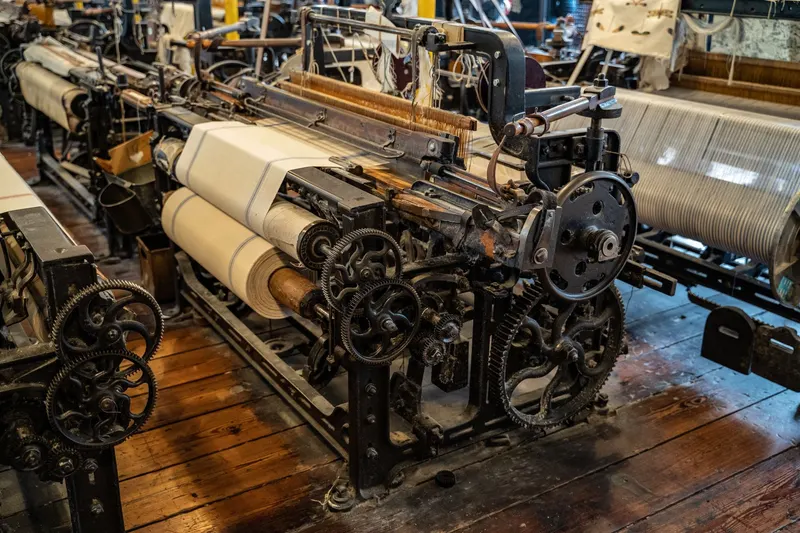
Until the eighteenth century, most cloth, tools, and household goods were made in homes and small workshops. In England, the so-called putting-out system sent wool and cotton to families who spun and wove at home, and merchants collected the finished goods. The arrangement was flexible, but it had limits. Quality varied, the pace of work was hard to control, and merchants depended on many small, scattered producers. The factory emerged partly as an attempt to solve these problems by gathering machines, a power source, and workers in one place under one management.
The word factory covers different things over time. A water-powered spinning mill in 1770, a steam-driven weaving shed in 1830, and an automobile assembly line in 1913 share the idea of centralized organization, but they are distinct technical arrangements.
How it works
An industrial factory is, above all, a technical system and not merely a building full of machines. It combines four elements: a central source of power, such as a water wheel or a steam engine; shafts, belts, and pulleys that carry that power to many machines; machines that perform repetitive operations; and an organization of labor that decides who does what and at what pace.
The textile case
Cotton was the pioneering industry because spinning and weaving could be divided into stages, each of which could be mechanized in turn. The spinning jenny, credited to James Hargreaves and developed in the mid-1760s (he patented it in 1770), let one worker spin several threads at once. The water frame, patented by Richard Arkwright in 1769, used rollers and water power to produce a strong, hard-twisted thread. Samuel Crompton's mule, from 1779, combined features of both. The power loom, patented by Edmund Cartwright in 1785 and improved by many others over the following decades, mechanized weaving.
In 1771, Arkwright and his partners opened a water-powered spinning mill at Cromford in Derbyshire, which ran in shifts and is often cited as one of the first factories in the modern sense. The Derwent Valley Mills, which include Cromford, are a UNESCO World Heritage Site. Arkwright was at once an inventor, an entrepreneur, and the target of patent disputes, and courts challenged the originality of some of his claims; his second patent, of 1775, covering the preparatory processes of carding and related steps, was overturned in 1785.
Clock discipline and the division of labor
When machines run continuously, time takes on a different meaning. Workers had to arrive together, stay for fixed shifts, and keep pace with the machinery. The historian E. P. Thompson, in an influential 1967 essay, described how attitudes to working time shifted from completing a task to obeying the clock. Bells, whistles, and time cards became part of factory life.
The division of labor was already a subject of economic thought. In The Wealth of Nations (1776), Adam Smith described a pin workshop where tasks split among several workers produced far more than the same people working separately. He was describing a manufacturing process, not necessarily machines. Mechanization was added on top of the division of tasks.
Machine tools and interchangeable parts
To build machines in quantity, makers needed metal parts cut with precision. Around 1800, Henry Maudslay in London refined the slide-rest lathe, which holds and guides the cutting tool mechanically instead of relying on the operator's hand. His workshop trained important engineers, among them Joseph Whitworth, who proposed a standard screw thread in 1841 that became widely used in Britain. Underlying all of this was the ability to work iron and steel, discussed in Metallurgy and the Mastery of New Materials.
The idea of interchangeable parts, components so uniform that any one fits in place of another, has several origins. In France, Honoré Blanc worked on it in the eighteenth century. In the United States, the federal armories at Springfield and Harpers Ferry spent decades developing gauges and fixtures to produce muskets with compatible parts. The familiar story that Eli Whitney demonstrated the system to the government in 1801 is partly myth: historians have shown that the demonstration was staged and that real uniformity came later, through the efforts of many engineers. In England, Marc Brunel, working with Maudslay, built a steam-powered block-making plant at Portsmouth dockyard in the first decade of the nineteenth century, often cited as an early example of machine mass production.
Power, transport, and communication
Factories operated at scale only because power, transport, and coordination existed. The steam engine freed industry from rivers. Railways carried raw materials and finished goods, and the telegraph made it possible to coordinate schedules and orders over distance. In the United States, the Boston Manufacturing Company was organized in 1813, and its mill at Waltham, Massachusetts, began operating in 1814. It brought spinning and weaving together under one roof. The mills at Lowell, Massachusetts, where the first factory opened in 1823, followed the model and employed many young women who lived in company boardinghouses.
Mass production and the assembly line
By the early twentieth century, the question was how to assemble complex products such as automobiles at low cost. In 1901, Ransom Olds organized production of the Oldsmobile Curved Dash in Detroit around specialized work stations, with parts brought to the workers, and by commonly cited figures output rose from several hundred cars that year to a few thousand the next. The cars did not yet travel on a powered conveyor. Henry Ford built on these ideas. At the Highland Park plant in Michigan, the Ford Motor Company introduced a moving assembly line in 1913, first for components and then for the chassis, and this sharply reduced assembly time. Earlier examples include the meatpacking houses of Cincinnati and Chicago, where carcasses traveled along overhead rails and each worker performed one cut, a process often called disassembly.
At the same time, the engineer Frederick W. Taylor argued in The Principles of Scientific Management (1911) that each task should be studied with a stopwatch to find a best method and a standard time. Taylorism became influential and controversial. Supporters saw greater efficiency. Critics saw a loss of autonomy and skill, and work reduced to repetition. Electricity also altered the layout of factories, since individual motors replaced the long overhead drive shafts, a change traced in How Electricity Moved from the Laboratory to Everyday Life.
Impact and limitations
The gains in productivity and the fall in the price of textiles and consumer goods were real, and urbanization drew millions of people from the countryside to the cities. The social costs were heavy. Early factories employed many children, for long hours, around unguarded machinery. British factory legislation advanced slowly. The Health and Morals of Apprentices Act of 1802 addressed the treatment of pauper apprentices in cotton and wool mills, and the Factory Act of 1833 barred children under nine from most textile mills, limited the hours of older children, and created a small corps of factory inspectors, though enforcement was weak at first. Air and water pollution and poor housing for workers were widespread.
Workers responded in different ways. The Luddites, textile artisans in parts of England active mainly between 1811 and 1813, smashed machines to protest lost livelihoods and falling wages, and the authorities suppressed them harshly. Their movement was more a struggle over working conditions and pay than a hatred of technology as such. Later, trade unions, strikes, and labor laws gradually shaped working hours, safety, and wages.
The debate over the term Industrial Revolution
The phrase is widely used, but historians dispute it. It was popularized in English through lectures by Arnold Toynbee in the early 1880s, though earlier uses exist. Studies by economic historians such as Nicholas Crafts and Knick Harley suggest that productivity growth was more gradual than the word revolution implies, and that change was concentrated in certain industries and regions. Others stress that the overall transformation of living and working patterns over several generations was profound. The debate continues, and many scholars prefer to speak of a process of industrialization.
Connections to other technologies
The modern factory ties together energy, materials, and communication. Without the steam engine and good-quality iron, the scale would have been impossible. In the twentieth century, automation continued the logic of standardizing and repeating tasks, now with programmable machines, a story told in Robotics: From Automatic Machines to Programmable Systems.