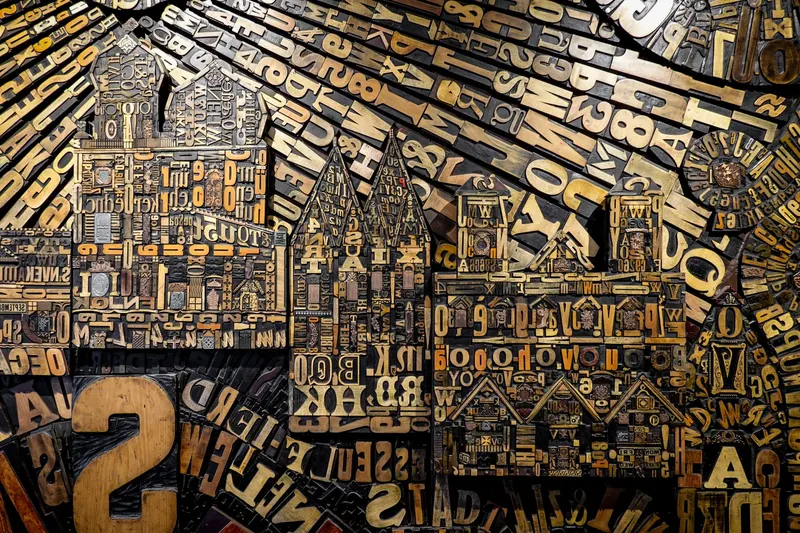
Before printing, every book was a one-off object. A scribe read an exemplar and copied it by hand, word by word. The work was slow and expensive, and errors piled up from copy to copy. Monasteries, universities and urban copying shops kept texts in circulation in Europe for centuries, but the number of copies was small, and prices limited access to institutions and wealthy individuals. The problem was how to repeat a text faithfully and at lower cost.
To credit one person with the solution oversimplifies the story. Mechanical reproduction of text grew out of a chain of innovations in Asia and Europe, and the achievement of Johannes Gutenberg in Mainz lay in assembling several of them into a working production system.
How it works
Letterpress printing rests on the idea of composing text from reusable pieces. Each letter is a piece of type: a small block of metal with the letter raised in reverse, like a mirror image, at one end. The compositor picks pieces of type from a case, sets them in lines, arranges the lines into a forme (the assembled page) and locks it into a frame. After the page is printed, the type is taken apart and returned to the case to be used again.
Several elements have to work together.
- The type. To make many identical pieces of each letter, a craftsman first cuts the letter in relief on a steel punch and strikes it into a piece of softer metal to form a matrix, the mold for the letter's face. The matrix is fitted into an adjustable hand mold, and molten metal is poured in. The alloy in the European tradition was lead-based, with tin and antimony added, because it melts at a low temperature, cools quickly and withstands repeated pressing. Researchers still discuss exactly which alloys and techniques Gutenberg's shop used, since little equipment survives.
- The ink. The water-based inks used for woodblocks in Asia ran off metal type. European printers developed a thicker ink made with oil and pigment such as lampblack, which clings to metal.
- The press. The screw press, already used for wine, olive oil and papermaking, was adapted to press the sheet evenly against the inked forme.
- The paper. The plentiful supply of paper in fifteenth-century Europe was a condition of the system. Parchment would have made large print runs unaffordable in most cases.
A print shop needed compositors, pressmen who inked the type and worked the press, and proofreaders. It was collective work with a division of tasks.
Historical context
Antecedents in Asia
Woodblock printing, in which a block of wood is carved in relief, inked and pressed to paper, was used in China and later in Korea and Japan to reproduce images and texts, particularly religious ones. Among the earliest surviving printed objects are the Buddhist charms known as the Hyakumantō Darani, produced in Japan between 764 and 770 (probably by woodblock, although recent scholarship allows that some were printed from metal plates), and the Diamond Sutra, printed in China in 868 and found at Dunhuang. The Diamond Sutra, now in the British Library, is usually cited as the earliest dated printed book.
Movable type appears in China in the eleventh century. The scholar Shen Kuo described in his Dream Pool Essays, written around 1088, how a commoner named Bi Sheng had made characters of baked clay and set them in an iron frame on a resinous mixture. Shen Kuo's account is the main source for this attempt, and no examples of Bi Sheng's type survive. In 1297 or 1298 the official Wang Zhen described a system of wooden type, and there were later experiments with metal. Written Chinese, with thousands of characters, made it harder to gain the economies of scale that an alphabet allows.
In Korea, during the Goryeo dynasty, printers developed bronze type cast in molds. A ritual text is recorded as having been printed with metal type in the thirteenth century, possibly as early as 1234, although that book is lost. The oldest surviving book printed with movable metal type is the Jikji, a collection of Buddhist teachings printed in 1377 at Heungdeok Temple. Only its second volume survives, held by the Bibliothèque nationale de France, and it is inscribed in UNESCO's Memory of the World Register (2001). In the fifteenth century, under King Sejong, new fonts of type were cast and the Korean alphabet, hangul, was created. No evidence shows that these advances reached Europe and influenced Gutenberg. The prudent course is to treat them as independent developments, and whether there was any transmission remains an open question.
Mainz, around 1450
Gutenberg was a goldsmith and entrepreneur from Mainz who had worked in Strasbourg in the 1430s. Around 1450 he was developing a system of movable metal type in Mainz, financed by loans from the merchant Johann Fust, who later sued him. Records of the 1455 lawsuit reveal something about the partnership and its debts but very little technical detail. Peter Schöffer, a trained scribe who joined Fust, also played a central part in the shop, and in 1457 Fust and Schöffer issued the Mainz Psalter, the first European printed book with a printed date and the names of its printers.
The best-known product is the 42-line Bible, or Gutenberg Bible, produced around 1454 to 1455. Estimates commonly put the run at about 180 copies, some on paper and some on vellum, and 49 copies are known to survive, of which 21 are complete and 28 partial. Copies were decorated by hand after printing, with colored initials and illustrations, which shows that the new technique coexisted with manuscript tradition. Before the Bible the workshop printed shorter items, including a grammar and indulgences (documents issued by the Church). Neither the exact date of the invention nor the contribution of each person in the shop is known with precision. The Dutch tradition that credits Laurens Janszoon Coster of Haarlem has been examined by historians and is not supported by the documentary evidence.
Within decades the technique spread to Strasbourg, Cologne, Venice, Paris, Lyon and many other cities. Books printed before 1501 are called incunabula, and the Incunabula Short Title Catalogue, begun at the British Library and now hosted by the Consortium of European Research Libraries, records roughly 30,000 editions, most of them in Latin. Venice became a leading center. There, Aldus Manutius and his workshop, with the punchcutter Francesco Griffo, introduced italic type and small octavo formats around 1500.
Impact and limitations
Printing reduced the cost of books and allowed texts to be standardized, which helped study and comparison. It contributed to the circulation of ideas in religious disputes such as the Reformation in the sixteenth century, when pamphlets and Bible translations reached large audiences, and to the dissemination of scientific works, maps and tables, since print could reproduce illustrations and data more consistently than copying by hand. Publishing in vernacular languages also influenced the fixing of spelling and grammar.
How far these changes reached is debated among historians. Elizabeth Eisenstein, in The Printing Press as an Agent of Change (1979), argued that printing was a transformative force behind the Reformation, the scientific revolution and European culture. Others, such as Adrian Johns in The Nature of the Book (1998), argue that the reliability of printed texts was never automatic and that trust in print depended on institutions, practices and disputes, including piracy and printing errors. Some scholars also stress that manuscripts continued to circulate for centuries.
There were practical limits. Printing required capital for presses, paper and type, and many shops failed. Civil and religious authorities practiced censorship, as with the Catholic Church's Index of Forbidden Books, first issued in 1559, and printing licenses restricted the trade in many countries. Reach depended on literacy, which remained limited, and many people encountered texts through reading aloud.
Connections to other technologies
Printing depends on paper and on advances in metallurgy, especially the casting of low-melting alloys. It is also tied to writing as a record-keeping technology, which concerns what is recorded and how information is organized. The mechanization of printing later connected it to factories and industrialization: Friedrich Koenig's steam-driven press was used by The Times of London in 1814, and Linotype and Monotype machines for composing type appeared in the 1880s. Newspapers with large circulations then created a demand for fast news that the telegraph would meet.