While a community is small, collective memory handles almost everything: who owes what, how many cattle exist, when to plant. As populations, stores, and the number of people involved in exchange and taxation grow, memory stops being enough. A way was needed to keep information outside anyone's head, pass it to people who were not present, and check it later. Writing was, among other things, an answer to this problem of administration.
How a writing system works
To write is to represent language with conventional signs, so that another person who knows the convention can recover the message. This separates writing from drawings or tally marks, which can store information without recording a language. Writing systems combine, in varying proportions, three kinds of signs:
- Logograms: signs that stand for whole words or ideas.
- Syllabic signs: signs that stand for syllables.
- Alphabetic signs: signs that stand for individual sounds, consonants and sometimes vowels.
No ancient system was pure. Cuneiform and Egyptian hieroglyphs, for example, mixed logograms and phonetic signs, and Chinese writing combines elements that suggest meaning with elements that suggest pronunciation.
Writing also needs a material chain: a surface (clay, papyrus, bone, bark, stone, wood, silk), a tool (reed stylus, brush, reed pen, chisel), and, when needed, a pigment (carbon ink, resins). Each combination shaped the form of the signs. In Mesopotamia, a reed stylus pressed into damp clay left wedge-shaped marks, which gave cuneiform ("wedge-shaped") its name. In Egypt, reed pens and ink on papyrus favored cursive forms.
Antecedents: tokens, marks, and records
Before texts, there were records that were not writing in the full sense. The archaeologist Denise Schmandt-Besserat, studying small clay tokens found in the Near East, proposed that tokens, found at sites from about 8000 BCE onward, served as a system for counting goods and that later the tokens were sealed inside clay envelopes (bullae), on whose surface marks were impressed to show the contents. Those marks would then have led to the numerical signs on tablets. The theory is influential but disputed on several points, including the direct continuity between tokens and writing (tokens kept being used alongside written records, which suggests a parallel rather than a strictly successive development) and the interpretation of individual tokens. It is now treated as an important hypothesis rather than established fact. The link to farm surpluses is discussed in Agriculture, Storage, and the Rise of New Techniques.
Mesopotamia: Uruk and accounting
The oldest known proto-cuneiform texts come from the city of Uruk, in southern Mesopotamia (present-day Iraq), from archaeological layers known as Uruk IV and III, which fall roughly between 3400 and 3000 BCE. Thousands of tablets have been found, and the great majority deal with administration: barley rations, head of cattle, textiles, and lists of professions and objects. There are also word lists used to train scribes. Very few examples resemble narrative, and none is literature.
That does not mean writing was invented only for counting. It is what the surviving evidence lets us say, and what survived is biased: dried or baked clay endures, while perishable materials vanish. Over time cuneiform was adapted to many languages, including Sumerian, Akkadian, and Hittite, and it served for legal documents, letters, religious texts, narratives such as the Epic of Gilgamesh, and collections of laws, among them the one attributed to Hammurabi, king of Babylon, in the eighteenth century BCE.
Other regions, independent inventions
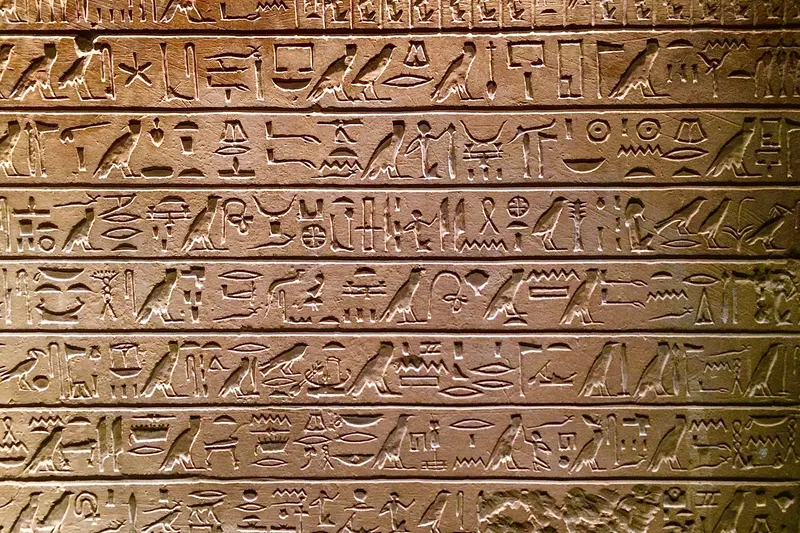
Egypt. Signs resembling hieroglyphs appear on some 150 small bone and ivory labels from Tomb U-j at Abydos, excavated by a German Archaeological Institute team and dated to around 3300 BCE, and Egyptian writing is well established by about 3100 BCE. Scholars debate whether it was inspired by Mesopotamia or was a local creation. Many take a cautious view: the idea of writing may have circulated, but the Egyptian system has features of its own.
Indus Valley. The cities of the Indus civilization produced seals bearing signs, which were common between about 2600 and 1900 BCE, with isolated signs on pottery from earlier phases. Most inscriptions are very short. These signs have not been deciphered, and it is not known with certainty which language they record, or whether all of them represent language at all. Any reading presented as definitive should be treated with caution.
China. The oldest fully recognizable Chinese writing consists of inscriptions on oracle bones and turtle shells from the Shang dynasty, associated with King Wu Ding and the site of Anyang, around 1250 BCE. They were questions put to ancestors in divination. There are signs on older Neolithic pottery, and specialists discuss whether they count as writing.
Mesoamerica. Writing systems emerged among peoples of the region, including the Zapotec and, later, the Maya. The Cascajal block, a stone slab with 62 signs reported in 2006 and linked to the Olmec culture, was dated by its publishers to about 900 BCE on the basis of associated debris. It is discussed as a possible early example, though its date, authenticity, and status as writing are questioned. Maya writing, which combines logograms and syllabic signs, is well documented from the Classic period, and older examples exist at sites such as San Bartolo.
The phrase "first writing" should be used with care. What can be said is that writing was created independently, or at least relatively independently, in more than one region, and that arguments about priority depend on how writing is defined and on new discoveries.
The alphabet
An alphabet is a system in which each sign stands for a sound, at first mostly consonants. The earliest signs come from inscriptions in Egypt (Wadi el-Hol) and the Sinai (Serabit el-Khadim), in a script called Proto-Sinaitic, whose signs appear to derive from hieroglyphs adapted by speakers of a Semitic language. Estimates range from about the nineteenth century BCE to the sixteenth century BCE, and the exact dating and number of stages are disputed. The surviving evidence then thins out, and inscriptions in the Phoenician alphabet, in use on the Levantine coast, are clearly attested from about the eleventh century BCE. From the Phoenician line came the Greek alphabet, adapted by roughly the eighth century BCE with the addition of vowel signs. The small number of signs made learning potentially quicker, but that does not mean people who used alphabets were more literate than those who used other systems.
Scribes, institutions, and impact
Writing was a craft. In Mesopotamia and Egypt, scribes trained for years in schools tied to temples and palaces, copying lists and texts. These specialists served institutions: temples, palaces, armies, and merchants. Writing made it possible to enlarge administrations, collect taxes, record contracts and laws, preserve genealogies, compose hymns and literature, and later spread knowledge in mathematics, astronomy, and medicine.
The limitations matter. Literacy was restricted to small parts of the population, such as officials, priests, and some merchants. Many societies maintained strong oral traditions, and some peoples developed other means of recording. The knotted-cord device used in the Andes, the quipu, is one example, and scholars still debate whether it recorded only numbers, or narrative as well. Writing also reinforced hierarchies: whoever controlled the record controlled part of memory and of the collection of dues.
Connections to other technologies
The materials of writing changed over time, from clay and papyrus to parchment and paper, a subject taken up in The Path of Paper as an Information Medium. The mechanical reproduction of texts took a leap with the printing press. And the idea of representing information with conventional signs, storing it, and processing it returns in a different setting in the first computers, which also deal with records, lists, and accounts.