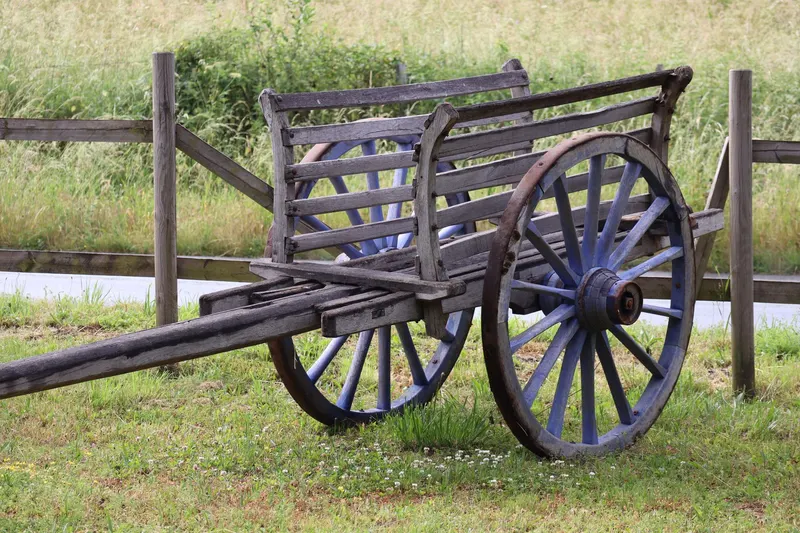
Moving a heavy load without a wheel means dragging it. Sledges glide well over snow, mud, or wet sand but demand great force on dry ground, and wooden rollers placed under a load have to be picked up and repositioned constantly. The wheel solved part of this problem by replacing sliding friction with rotation around an axis. But the wheel is only the most visible example of a larger idea: turning force into continuous rotation in order to carry loads, grind grain, lift water, or shape objects.
How it works: wheel, axle, and friction
A vehicle wheel is useful only together with an axle, the bar around which it turns. In the earliest known form, the axle was fixed to the wheels and turned with them, held in bearings under the body of the cart. Later the opposite arrangement spread, with a fixed axle and wheels that spin freely on it. The place where one part turns against another is the hub or the bearing, and there lies the main technical problem. Without lubrication and a good fit, friction wears down the wood and wastes the energy of whoever is pulling. The use of animal fat and the choice of hard woods for each part belong to the story.
This explains why the wheel did not arise as just any disk. Making two parts that turn with enough clearance not to jam, yet little enough not to wobble, takes precise joinery. The demand is one reason historians treat the wheel as an achievement that depended on already developed crafts, especially carpentry.
The potter's wheel and the vehicle wheel
Two uses of rotation are often confused. The potter's wheel is a turntable on which clay is shaped. The earliest versions, slow and turned by hand, appear in the Near East in the fourth millennium BCE or perhaps earlier, and they helped in finishing vessels. The fast wheel, which lets a potter raise the walls of a vessel using steady spinning and centrifugal force, is associated with later periods in Mesopotamia, from about the late fourth and third millennia BCE onward. Dating is uncertain, and it cannot be said with confidence that one device gave rise to the other; some researchers treat them as separate lines of development.
The vehicle wheel appears clearly from about 3500 BCE. Three kinds of evidence stand out:
- A ceramic vessel from Bronocice, in present-day Poland, decorated with what appears to be a drawing of a four-wheeled vehicle, attributed to the Funnel Beaker culture and dated by radiocarbon to the middle of the fourth millennium BCE, about 3500 to 3350 BCE by commonly cited figures.
- Pictographic signs from the city of Uruk, in Mesopotamia, from around 3200 BCE, which include the image of a sledge mounted on wheels.
- The Ljubljana Marshes wheel, found south of Ljubljana, Slovenia, with a wheel of ash and an oak axle about 1.2 meters (4 feet) long. Radiocarbon dating of the wood indicates an age of roughly 5,100 to 5,350 years, or about 3300 to 3100 BCE, often summarized as about 3150 BCE. Wheel and axle were fixed together, since the axle passes through a square hole. Because it is a wooden object preserved in waterlogged ground, it is one of very few actual wheels from this period.
Graves in the steppes north of the Black and Caspian Seas, from about 3000 BCE, contain wagons or their parts, which helps show that the technology spread quickly across wide areas. A little later, in the mid-third millennium BCE (the British Museum dates it to about 2550 to 2400 BCE), a Sumerian inlaid panel known as the Standard of Ur shows solid-wheeled battle carts drawn by equids, animals of the horse family that were probably onagers or donkeys.
One origin or several?
Because nearly contemporary traces exist in distant areas, specialists have no consensus on where the wheel was invented. Some propose a single center of invention followed by rapid diffusion, while others allow for parallel development. The scarcity of preserved wood makes the question harder: wheels may have existed in regions where nothing survived. The safest statement is that wheeled vehicles appear from the middle of the fourth millennium BCE across a broad zone between Europe and Mesopotamia.
Spokes, chariots, and improvements
The first wheels were solid, made of joined planks, heavy and hard to steer. The spoked wheel, built from a rim, a hub, and thin rods, is much lighter and allows speed. The earliest known examples come from burials of the Sintashta culture in the steppes south of the Urals, dated by recent studies to roughly 2000 BCE, give or take a century or two, and over the second millennium BCE it spread among peoples of the Near East, Egypt, and Asia, together with horse-drawn chariots. These vehicles depended on a combination of horse breeders, specialized carpenters, and usually a state able to pay for them. Wheels later gained rims reinforced with metal, and the fitting of hubs and bearings improved over time.
Rotation beyond transport
Turning motion was applied to many other tasks:
- Lathe: a piece of wood turns while the craftsman cuts it with a tool. In early versions, a cord wrapped around the piece and pulled back and forth by a bow made it spin alternately in each direction.
- Pulley: a grooved wheel for rope that changes the direction of a pull and, in combinations, reduces the effort needed to lift loads.
- Noria: a wheel with containers attached to its rim, driven by flowing water or by animals, used to raise water from a river or well.
- Watermill: a wheel turned by a current drives millstones to grind grain. The treatise of the Roman architect Vitruvius, from the first century BCE, describes a vertical-wheel mill that drives the stones through gearing.
- Gears: toothed wheels that transmit and change motion. The Antikythera Mechanism, a Greek device of the Hellenistic period (dated to roughly the second or first century BCE), is the most sophisticated known example of gear trains from that age.
- Windmill: vertical-axis windmills are documented in the Persian region, traditionally placed around the ninth and tenth centuries CE, and horizontal-axis windmills appear in Europe from the late twelfth century, according to written records.
These mechanisms allowed the energy of rivers, wind, and animals to be put to repetitive work, a process that set the stage for Machines and Engineering Solutions of Antiquity and, much later, for the steam engine.
Why not everyone adopted the wheel for transport
A common mistake is to assume the wheel was an "obvious" invention that any society would adopt. Societies in the Americas before contact with Europeans did not use wheeled vehicles for transport, although the idea was known: ceramic figures with wheels have been found in Mesoamerican sites and are interpreted as toys or ritual objects. Proposed explanations include the lack of large domesticated draft animals, the mountainous terrain of regions such as the Andes, and the efficiency of alternatives such as human carriers and llamas. None of these is definitive, and some are debated. The lesson is that a technology makes sense only within a set of conditions: roads, animals, materials, and needs.
Impact and limitations
The wheel and rotating mechanisms increased the ability to move and process materials, encouraged trade, and changed warfare. But they require reasonably level routes, and not every landscape offers them. In addition, the efficiency of milling or water-lifting depended on infrastructure such as dams and channels, whose construction required large collective labor and, in many cases, forced labor.
Connections to other technologies
Making axles, rims, and hubs drew on metallurgy, for example in carpentry tools and fittings. In time, rotation was linked to large machines: turbines, industrial waterwheels, and the transmission shafts of nineteenth-century factories, which relied on systems of pulleys and belts driven from a single power source.