A large city needs clean water, food, roads for people and goods, and buildings that stay up. In the first urban societies each of these problems ran into the same constraints: the limited strength of human and animal muscle, a shortage of durable building materials, and a lack of precise measuring instruments. The builders of antiquity rarely held anything like the title of engineer. They were called architects, master builders, surveyors or overseers. Their answers combined observation, inherited rules of thumb and the organization of very large work crews.
The period covered here runs from about 3000 BCE to about 500 CE, but most of the examples cluster between the third century BCE and the first century CE, when the Hellenistic and Roman worlds left treatises, inscriptions and structures that survive today.
How it works
Moving water: aqueducts, qanats and cisterns
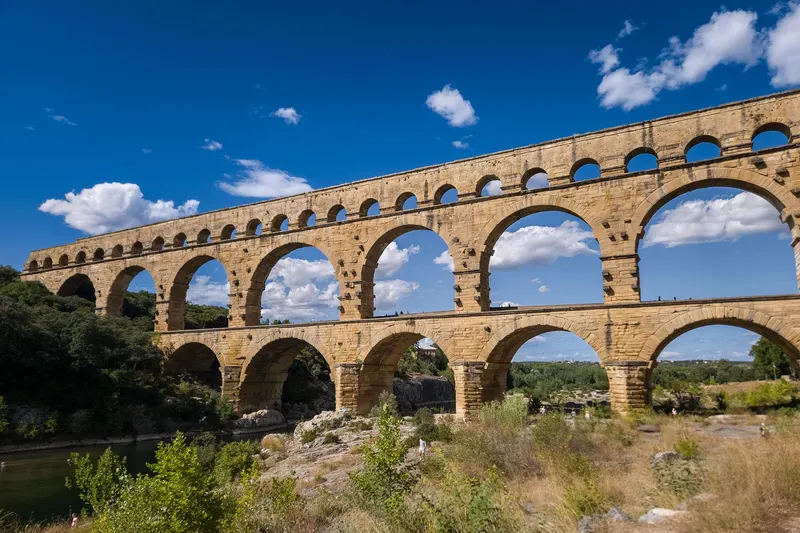
An aqueduct is a system of channels, tunnels and bridges that carries water by gravity from a high source to a town. The key is a very gentle slope. Over long stretches the channel might fall only a fraction of a percent, which demanded careful surveying. The Roman architect Vitruvius, who wrote a treatise on architecture in the late first century BCE, describes the chorobates, a long leveling bench fitted with plumb lines and a water trough. Where the route crossed a deep valley, builders could carry the channel on tiers of arches. Alternatively, they could send the water down and back up through sealed lead or stone pipes, forming what is now called an inverted siphon.
Sextus Julius Frontinus, who was put in charge of Rome's water supply in 97 CE by the emperor Nerva, wrote a report on the city's aqueducts in his role as water commissioner (curator aquarum). It describes sources, lengths, delivery quantities and even illegal taps on the system. It is a rare surviving account of public infrastructure management in antiquity.
In dry regions, such as the Iranian plateau, communities built qanats: nearly horizontal tunnels dug from a line of vertical shafts that tap groundwater at the foot of mountains and lead it to villages and fields with little loss to evaporation. Qanat systems are attested in Iran by the first millennium BCE. Cisterns, covered reservoirs, secured rainwater for cities without nearby rivers. The great underground Basilica Cistern of Constantinople, built in the sixth century CE under Justinian, is one example.
Roads, arches and concrete
Roman roads were built in layers: a foundation of stones, a bed of gravel, and a surface of paving slabs or compacted gravel, with ditches at the sides for drainage. Many were not paved with stone at all. Their purpose was partly military and administrative, but they carried trade and the official mail as well. The Via Appia, begun in 312 BCE, is the best-known early example.
The arch lets a builder span a gap wider than a stone beam can cross, because it turns the load into compression, a force stone resists well. The Romans paired the arch with concrete, a mixture of lime, volcanic ash (pozzolana), water and chunks of rock or brick. It sets even underwater, and they used it in harbors, vaults and the dome of the Pantheon in Rome, whose construction probably began under Trajan and was completed under Hadrian, with dedication usually placed in the mid-120s CE (brick stamps in the structure are mostly of the early 120s). With an interior diameter of about 43 meters (142 feet), that dome is unreinforced concrete. A 2023 study published in Science Advances by researchers at the Massachusetts Institute of Technology and partner institutions proposed that small white lumps of lime in the mix, which point to hot mixing with quicklime, could dissolve and recrystallize to seal cracks. Why parts of Roman concrete lasted so long is still under study, and not every site used the same recipe.
Machines: simple and compound
Levers, pulleys, wedges and inclined planes had been known for a very long time. Romans combined pulleys and windlasses in cranes. Some were driven by a treadwheel, a large wheel inside which workers walked. A relief from the tomb of the Haterii, a family of builders, made in Rome in the late first or early second century CE and now in the Vatican Museums, shows such a crane. Such machines multiply force, but they still depend on people to power them.
The water mill was one of the few ancient machines to draw on a power source other than muscle. Vitruvius describes a vertical-wheeled mill in which gearing passes the motion of the water wheel to the millstones. Adoption was slow but steady. At Barbegal, near Arles in southern France, the remains of a complex with sixteen water wheels arranged in two rows down a hillside are usually dated to the second century CE. A 2018 study of mineral deposits left on the wooden parts suggests the complex ran seasonally, perhaps to make hard biscuit for nearby harbors, rather than steadily supplying flour to a large city as earlier scholars assumed. A relief from Hierapolis in present-day Turkey, from the third century CE, shows a water-powered saw cutting stone.
Among hydraulic devices, Ctesibius of Alexandria (third century BCE) is linked to a force pump with two pistons, to an improved water clock and to the water organ. The water screw, a spiral inside a tube that lifts water as it turns, is traditionally credited to Archimedes, but the attribution is debated. Ancient authors describe similar devices in Egypt, and one scholar has argued that Mesopotamian engineers used a screw much earlier. That suggestion is contested.
Historical context
Hero of Alexandria, who probably worked in the first century CE, wrote on mechanics, pneumatics and automata. His aeolipile, a sphere that spins when steam escapes through bent nozzles, appears in his writings, but it seems to have been a demonstration piece with no known practical use. The example is a useful warning. A working principle inside a device does not mean that a society will turn it into production technology.
Another remarkable case is the Antikythera Mechanism, found by sponge divers in 1900 and recovered from a shipwreck near the Greek island of Antikythera during salvage work in 1900 and 1901. It was taken to the National Archaeological Museum in Athens, where a gear was noticed in a corroded lump in 1902. The mechanism is an assembly of bronze gears dated by different studies to the second or early first century BCE; the research project favors about the end of the second century BCE. It modeled astronomical cycles, including the movements of the Sun and Moon, the lunar calendar and the cycle used to predict eclipses, and it had dials showing the timing of various festivals and games. Researchers, among them the international Antikythera Mechanism Research Project, continue to decipher its inscriptions and to debate details such as how it displayed the planets and who made it. It is notable for a degree of gear-cutting and mechanical calculation that has no known parallel for many centuries afterward.
Vitruvius's De architectura collected knowledge on building, water, machines and sundials. It is an essential source, but it reflects the knowledge of a particular elite at a particular time. To learn what was actually built, historians cross-check texts against excavations, inscriptions and surviving structures.
Large-scale engineering was not confined to the Mediterranean. Mesopotamia, Egypt, India, China and the Americas all produced irrigation canals, dikes, pyramids, roads and agricultural terraces. The Great Pyramid of Khufu at Giza, built around 2560 BCE, was raised with ramps, sledges and a workforce that archaeology has shown to have been organized, housed and fed by the state. The emphasis on Greece and Rome in many accounts owes something to the quantity of texts and ruins that survive from them.
Impact and limitations
Ancient engineering made larger cities possible, along with water networks, public baths, harbors and roads that held empires together. The limits were also real. Energy came mostly from muscles. Complex machines were rare, built to order and dependent on skilled craftsmen. Materials such as wood and bronze had limited strength.
Historians have long debated why antiquity, which knew about gears, steam reaction devices and pumps, produced no industrial revolution. Explanations that have been offered include the abundance of cheap labor, including enslaved labor, which would have reduced the incentive to save work; the lack of large markets for mass-produced goods; and the absence of institutions linking the learning of treatises to the practice of workshops. No single explanation is accepted by everyone, and many scholars point out that the picture of an uninventive antiquity is misleading, given the real advances in mills, presses and construction methods.
Enslaved and coerced labor built much of what stands today, and conditions in mines and quarries were brutal. Studying these works also means recognizing who built them and at what cost.
Connections to other technologies
The wheel and rotating mechanisms underlie cranes, mills and the gear trains of the Antikythera Mechanism. Metallurgy supplied bronze for gears, iron for clamps and masons' tools, and lead for water pipes. In measurement and orientation, the practical astronomy behind the Antikythera Mechanism connects to instruments of navigation such as the astrolabe.
The idea of turning heat into motion, hinted at in Hero's aeolipile, became practical only many centuries later with the steam engine, which required new materials, a theory of pressure and an economic reason such as draining mines.