In the early 1700s, coal heated British homes and fed furnaces, but getting it out of the ground ran into a constant obstacle: water. As mines went deeper, the shafts flooded, and draining them took pumps driven by horses, water wheels, or the labor of many people. Horses were expensive to feed, and water wheels needed a stream, which rarely happened to run past the mouth of a mine. The steam engine began as an answer to this practical problem. Only later did it become a general source of power for mills, ships, and trains.
A common summary says that James Watt invented the steam engine. That is inaccurate. People had known for centuries that steam could do mechanical work, and several inventors had built working devices before Watt. What Watt did, together with partners, financiers, and skilled machinists, was to make the engine far more efficient and adapt it to new uses.
How it works
The basic principle is simple. When water boils it turns into steam, which takes up far more space than the liquid. If steam is trapped in a cylinder closed by a piston (a plug that slides back and forth, like the plunger of a syringe), it can push the piston. If the steam is cooled, it turns back into water, its volume collapses, and the pressure drops. Steam engineering consists of exploiting these two effects, expansion and contraction, and turning them into useful work.
The atmospheric engine
In the first engines, steam did not push directly. In Thomas Newcomen's engine, whose first well-documented installation was at Dudley Castle in the English Midlands in 1712, steam filled a cylinder and was then cooled with a spray of cold water. As the steam condensed it left a partial vacuum, and the weight of the atmosphere pressed the piston down. That is why such machines are called atmospheric. The piston hung from a chain attached to a large rocking beam, and the other end of the beam worked a pump rod reaching down the mine shaft.
The weakness of this design was wasted heat. Each cycle, the cylinder was heated by steam and then chilled by water, so much of the fuel went simply to rewarming the metal. The engine burned a great deal of coal, which made it economical mainly where coal was nearly free, at the coal mines themselves.
Watt's separate condenser
James Watt was an instrument maker working at the University of Glasgow. Asked to repair a small model of a Newcomen engine in the early 1760s, he noticed the waste and worked out a remedy. Developed through the 1760s and patented in 1769, his idea was to condense the steam in a separate chamber connected to the cylinder by a valve. The cylinder could then stay hot all the time while condensation happened elsewhere. Later accounts often say Watt's engines burned roughly a quarter to a half as much coal as a Newcomen engine doing the same work. The figure depends heavily on which Newcomen engine is used for comparison (those were also improved over the years) and on how the test was run, so it should be read as an approximation, not a fixed number.
Watt's ideas needed money and workshops. In 1775, after Parliament extended his patent to 1800, Watt formed a partnership with the Birmingham manufacturer Matthew Boulton, whose Soho works could build engines in quantity. Another indispensable figure was John Wilkinson, an ironmaster who developed a method of boring iron cylinders accurately. Without well-machined cylinders, steam leaked past the piston. This is a good example of how one invention rests on others, in this case on the skills described in Metallurgy and the Mastery of New Materials and in the precision machining that grew from them.
Between 1781 and 1784, Watt patented further improvements: the sun-and-planet gear, which converted the beam's rocking into rotation; the double-acting piston, in which steam pushes in both directions; and the parallel motion linkage, which guided the piston rod in a nearly straight line. Rotary motion changed the machine from a pump into a power source that could turn mill shafts, hammers, and looms. Watt chose the sun-and-planet gear partly because a simple crank was already covered by someone else's patent.
Antecedents
The idea of using steam to produce motion is old. Hero of Alexandria described a spinning steam device, the aeolipile, in the first century CE, but it was a curiosity, not a working tool, and belongs to the tradition of mechanisms discussed in Machines and Engineering Solutions of Antiquity. In the seventeenth century, experiments on air pressure and the vacuum by Evangelista Torricelli, Otto von Guericke, and Blaise Pascal prepared the ground. Denis Papin, in the 1690s, proposed a piston driven by steam and condensation.
The first commercially used steam device was Thomas Savery's pump, patented in 1698 and marketed as the Miner's Friend. It had no piston. Steam filled a vessel and was condensed, and the resulting vacuum sucked water up from below. It worked only over limited heights, and its vessels could burst. Newcomen, an ironmonger from Dartmouth in Devon, worked out the piston-and-beam design. Because Savery's broad patent covered condensing steam to raise water, Newcomen's engine was built under a shared arrangement with the patent holders.
High pressure and the locomotive
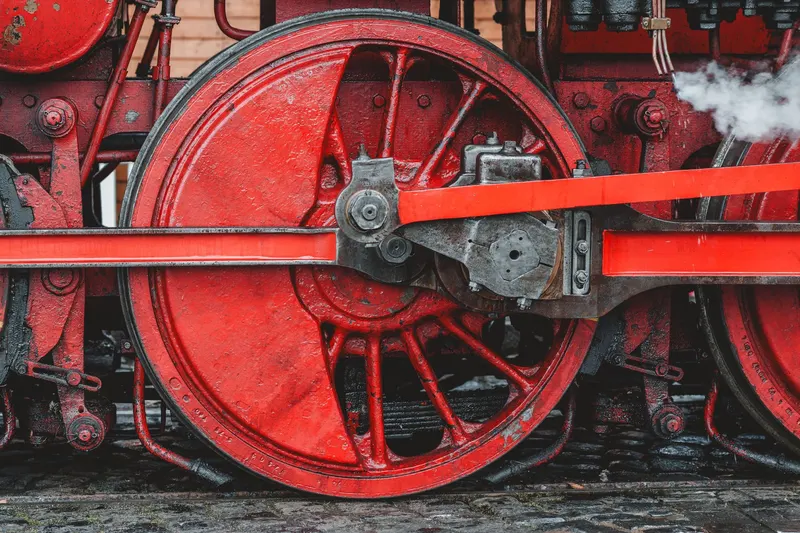
When Watt's patent expired in 1800, engineers were free to try high-pressure steam. Richard Trevithick, a Cornish engineer, built compact engines that used steam at much higher pressure and did not need a condenser, so they were small enough to be mounted on wheels. On February 21, 1804, one of his locomotives hauled about ten tons of iron and a large party of passengers along the Penydarren tramroad in South Wales, a run of roughly nine and a half miles from the ironworks at Merthyr Tydfil to the canal at Abercynon. Museums and historians treat it as the first authenticated journey by a steam locomotive on rails. The locomotive, however, was heavy for the brittle cast-iron plates of the track, which are said to have broken under it, and it did not go into regular service. Watt had been wary of high pressure, fearing boiler explosions, and the concern was not unfounded.
From rail to river
Practical railways came in the following decades. George Stephenson and his son Robert entered the locomotive Rocket in the Rainhill trials of October 1829, where it was the only competitor to complete the test. The Liverpool and Manchester Railway, opened in September 1830, was an early line built from the start for timetabled passenger and freight service powered by steam, and it is often described as the first intercity railway of its kind. On water, Robert Fulton's Clermont operated successfully on the Hudson River in 1807, after earlier attempts by inventors such as John Fitch and William Symington. Within a few decades, steamships were crossing the Atlantic, though for a long time they combined sails and engines.
Science follows practice
Theory arrived after the machine. In 1824, the French engineer Sadi Carnot published reflections on the motive power of fire, arguing that the efficiency of a heat engine depends on the temperature difference between its hot and cold parts. That work is among the roots of thermodynamics, developed through the nineteenth century by Clausius, Kelvin, Joule, and others. The steam engine, in a sense, created problems that physics then had to explain.
Impact and limitations
With steam, factories no longer had to sit beside rivers and waterfalls. They could be built near cities, ports, and labor markets. Demand for iron, for boilers, cylinders, and rails, pushed ironmaking forward, and demand for fuel pushed coal mining forward, creating a mutually reinforcing cycle. The wider consequences are the subject of Factories and the Technical Systems of Industrialization.
The human and environmental costs were heavy. Coal smoke darkened industrial cities, and deep mining exposed workers, including children, to roof falls, bad air, and long shifts. Boiler explosions killed workers and passengers throughout the nineteenth century, and this gradually led to inspection rules and manufacturing standards. Rapid urban growth packed families into crowded districts with poor sanitation.
Why Britain?
Historians debate why steam power developed and spread first in Britain. One explanation stresses cheap coal near the mines combined with relatively high wages, which made mechanization pay. Another points to a dense culture of workshops, scientific societies, and personal networks linking scientists, makers, and businessmen. Others emphasize institutions, markets, and colonial trade. There is no consensus on a single cause, and the safest reading is that several conditions combined.
The pace of change is also debated. Water power remained important in many industries well into the nineteenth century, and steam was adopted gradually and unevenly, depending on the trade and the region.
Connections to other technologies
Steam belongs to a long tradition of harnessing natural forces, which includes the water wheels and mechanisms of Machines and Engineering Solutions of Antiquity. Its development depended on iron, machined cylinders, and boilers that could be trusted, themes developed in Metallurgy and the Mastery of New Materials.
Steam later had a central role in electricity. Charles Parsons's steam turbine, first developed in 1884, uses steam to spin blades instead of pushing a piston, and it proved well suited to driving generators. To this day, most of the world's electricity comes from cycles that boil water, whether by burning fuel or through nuclear fission. That continuity is explored in How Electricity Moved from the Laboratory to Everyday Life.