Until the nineteenth century, anyone who wanted light used candles, oil lamps, and, in cities, gas. Anyone who wanted power relied on muscle, water, wind, or steam. Electricity was known as a phenomenon, in sparks from friction and in parlor demonstrations, but there was no practical way to produce it in quantity or carry it to where it was needed. The challenge was not only to invent devices. It was to build a system, with generation, distribution, and appliances that worked together.
The change was collective and slow. It involved physicists who investigated the nature of electricity, inventors who built devices, businesspeople who financed networks, and governments that set the rules. Telling the story as the work of one person, especially in the case of the light bulb, oversimplifies the process.
How it works
An electric circuit is a closed path along which electric charge moves, pushed by a difference in electrical potential, measured in volts. The rate of flow is the current, measured in amperes, and what opposes it is resistance. The energy delivered per unit of time is power, measured in watts.
From battery to generator
A battery produces electricity through chemical reactions. The first practical one was Alessandro Volta's pile, announced in 1800, made of discs of different metals separated by moistened material. It produced a steady current, unlike static electricity, and opened the way to electrochemistry and to early applications such as the telegraph.
For power on a large scale, batteries were too costly. The key was the link between electricity and magnetism. In 1820, Hans Christian Ørsted observed that a current deflects a compass needle, and André-Marie Ampère developed the mathematics of the interaction. In 1831, Michael Faraday demonstrated electromagnetic induction: moving a magnet near a coil of wire, or changing a magnetic field around it, produces a current in the wire. Joseph Henry in the United States made similar observations at about the same time.
A generator applies this principle. A coil spins in a magnetic field, driven by a steam engine or a water turbine, and produces current. An electric motor works in reverse: current in a coil inside a magnetic field makes it turn. This is what allowed electricity to be converted back into mechanical power.
Early generators used permanent magnets. In 1866 and 1867, the principle of self-excitation was announced by several people almost at once: Werner Siemens in Germany, and Charles Wheatstone and the Varleys (Cornelius and Samuel Alfred) in Britain, with Henry Wilde's machines of 1866 also in the picture. Earlier proposals by Søren Hjorth in Denmark and Ányos Jedlik in Hungary had led to no commercial development. In a self-excited machine, the generator's own output feeds the electromagnets that create its magnetic field, which made machines far more powerful. The Belgian engineer Zénobe Gramme built on the ring-shaped armature that the Italian Antonio Pacinotti had constructed around 1860 and published in 1865, and his dynamo of around 1870 to 1871 was widely used commercially.
Historical context
Before the battery
In the eighteenth century, electricity was studied with friction machines and the Leyden jar, a container that stored charge, developed around 1745 and 1746 by Ewald von Kleist and, independently, by Pieter van Musschenbroek. Benjamin Franklin investigated the electrical nature of lightning and proposed the lightning rod. His kite experiment of 1752 is well known, though the details of what happened are debated.
The lamp
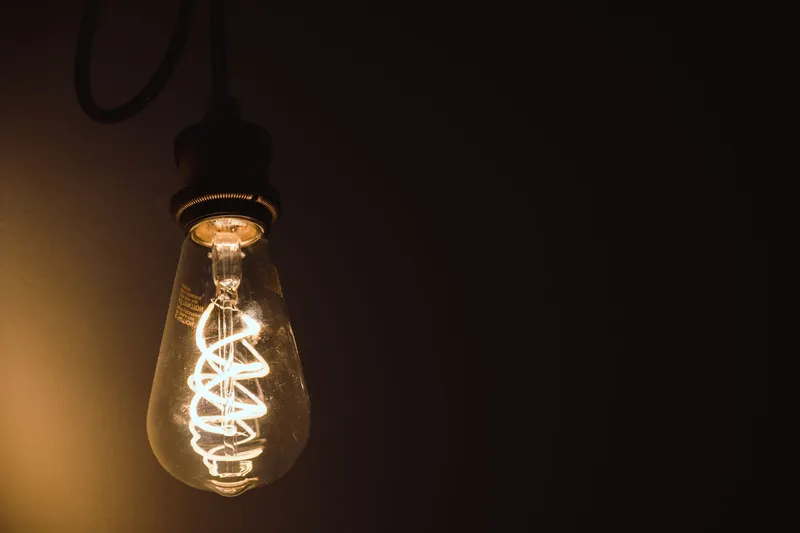
Electric light followed two paths. The arc lamp, in which current jumps between two carbon rods, was demonstrated by Humphry Davy in the early 1800s and adopted for streets and large spaces from the 1870s, but its light was too intense for homes. The incandescent lamp passes current through a filament that heats until it glows, inside a bulb from which the air has been removed so that the filament does not burn up.
Many inventors worked on it. Joseph Swan in England showed carbon-filament lamps to audiences in Newcastle in December 1878 and February 1879. Thomas Edison and his team at Menlo Park, New Jersey, produced durable, high-resistance carbon-filament lamps in 1879, and their public demonstration came at the end of that year. After patent disputes, the two sides merged their British interests in a joint company in 1883. What distinguished Edison's effort was the design of a complete system: lamps, generators, wiring, meters, and billing, not the lamp alone.
The first networks
In January 1882, a station at Holborn Viaduct in London began supplying electricity to a few customers. On September 4, 1882, the Edison Electric Illuminating Company started the Pearl Street station in Lower Manhattan, which supplied lamps with direct current over a small district of New York City. Direct current had a limit: it lost energy over long distances, so power plants had to sit close to customers.
The so-called war of the currents
In the 1880s, alternating current, in which the direction of flow reverses many times a second, showed an advantage: transformers could raise the voltage to send power over long distances with smaller losses, then lower it again before use. George Westinghouse, working with engineers such as William Stanley, backed this approach, and Nikola Tesla's alternating-current motor patents of 1888 were acquired by his company. Edison, whose business rested on direct current, campaigned against alternating current, stressing its safety risks.
Calling this a war is a simplification. It was a commercial, technical, and patent contest involving many players, and it ended in a mixture of solutions. Alternating current prevailed for transmission, yet direct current stayed important in particular uses and has returned in high-voltage transmission lines and in electronics.
Long-distance transmission was shown in Germany in 1891, when a three-phase alternating-current line carried power about 175 kilometers from Lauffen to Frankfurt for an electrotechnical exhibition, in a project that involved Oskar von Miller, Michail Dolivo-Dobrowolsky, and engineers of the Swiss firm Oerlikon. At Niagara Falls, the Adams power station, built by the Cataract Construction Company with engineers from several countries, began generating on August 26, 1895. On November 16, 1896, electricity from Niagara began to flow to Buffalo, New York, some 25 miles (about 40 kilometers) away, a landmark for alternating-current transmission using a hydraulic source.
Impact and limitations
Once networks existed, electricity changed factories. Instead of one large steam engine with shafts and belts, each machine could have its own motor, allowing more flexible layouts, as described in Factories and the Technical Systems of Industrialization. Electric streetcars, elevators, subways, and later household appliances such as irons, refrigerators, and washing machines reorganized cities and domestic work. Electric lighting extended the working day and reduced the fire risks tied to open flames.
The spread was uneven. Private companies put urban areas first, where customers could pay, and the countryside lagged. In the United States, the Rural Electrification Administration, created by executive order in May 1935, financed cooperatives to bring power to farms, at a time when only about one farm in ten had central-station electric service. In many regions of the world today, part of the population still lacks reliable access, according to surveys by international organizations.
Other limits persist. Generation still relies heavily on fossil fuels, which carry environmental costs. Dams alter rivers and displace communities. Poorly installed wiring causes shocks and fires, which led to technical codes and to the formation of electrical engineering societies that helped standardize practice.
Connections to other technologies
The earliest use of electric current was communication: the telegraph ran on batteries and wires before power grids existed. Large-scale generation, meanwhile, inherited the steam engine, since steam turbines drive most thermal generators. In the twentieth century electricity made electronics possible: vacuum tubes and then the transistor, which controls currents on a tiny scale and opened the road to computing.