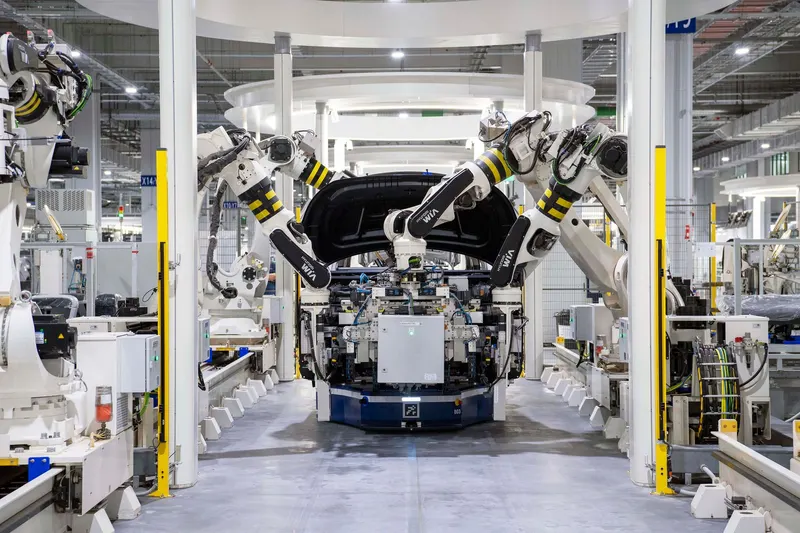
Long before robots, there were machines that repeated movements by themselves. Clocks, music boxes and articulated figures carried out fixed sequences set by gears, cams and weights. The trouble was that these machines could not be reprogrammed without being taken apart, and they did not react to their surroundings: if an object was out of place, the mechanism carried on as if nothing had happened. Modern robotics grew from combining three elements: actuators that produce controlled motion, sensors that report on the state of the world, and a programmable controller that decides what to do with that information.
How it works
A robot is usually described in terms of three subsystems. Actuators, such as electric motors and hydraulic or pneumatic cylinders, move the joints. Sensors measure joint positions, forces, distances, images or contact. The controller, today a computer, runs the program and computes commands for the actuators. The link among them is feedback: the system compares what was measured with what was wanted and corrects the difference. The idea was systematized in cybernetics, a term and field proposed by the mathematician Norbert Wiener in his 1948 book Cybernetics, which dealt with control and communication in animals and machines.
A typical industrial arm has several joints, each with a motor and a position sensor. To bring the tool to a point, the controller solves a geometric problem called kinematics, which translates the desired position of the tool into an angle for each joint. An operator can teach movements by guiding the arm by hand and recording the points, or write the program in a dedicated language. For mobile robots there is the added task of locating themselves and planning paths, which depends on perception and on models of the environment.
Antecedents: automatons
Descriptions of automatic devices appear from antiquity. Hero of Alexandria, a Hellenistic or early Roman author, described mechanisms driven by air, steam and water, including automatic theaters operated by cords and weights. In the medieval Islamic tradition, the engineer Al-Jazari completed around 1206 a treatise on ingenious mechanical devices, describing about fifty machines, among them water clocks with moving figures, fountains and automated serving devices. In 18th-century Europe, watchmakers built intricate automatons. Pierre Jaquet-Droz, his son Henri-Louis and Jean-Frédéric Leschot built at La Chaux-de-Fonds, in present-day Switzerland, between 1768 and 1774 three figures, the Writer, the Draughtsman and the Musician, which wrote, drew and played a miniature organ. Their movements were governed by cams, and the Writer could be set to spell out different texts. The figures now belong to the Neuchâtel museum of art and history. These were demonstrations of skill and entertainment, not working tools. The notion of interchangeable control, as in looms guided by punched cards, connects to the history of factories and industrialization.
Historical context
The word robot comes from the Czech robota, meaning forced labor or servitude. It was popularized by the play R.U.R. (Rossum's Universal Robots) by the Czech writer Karel Čapek, written in 1920 and published that year. An amateur company in Hradec Králové gave the first performance on January 2, 1921, and the National Theatre in Prague staged it on January 25, 1921. Čapek himself credited his brother, the painter and writer Josef Čapek, with coining the term. In the play the robots were artificial beings produced chemically, not metal machines, and the work dealt with labor and dehumanization. Fiction later shaped public imagination: Isaac Asimov, in stories from the 1940s, formulated the Three Laws of Robotics, fictional rules used as a narrative device with no counterpart in technical standards actually applied to robots.
In research, the neurophysiologist W. Grey Walter built at the Burden Neurological Institute in Bristol, in 1948 and 1949, small vehicles nicknamed tortoises (the first two were named Elmer and Elsie), with light and touch sensors and simple circuits. They displayed behaviors such as seeking light and backing away from obstacles, showing that a handful of components reacting to the environment could produce seemingly complex conduct.
The industrial robot emerged from the collaboration of the inventor George Devol and the engineer Joseph Engelberger. Devol filed a patent application for a programmed article-transfer device on December 10, 1954; the patent, U.S. 2,988,237, was granted on June 13, 1961. Devol and Engelberger, who met in 1956, founded the company Unimation in 1962 to develop the Unimate. In 1961 a Unimate was installed at a General Motors plant in Ewing Township, New Jersey, to lift hot parts from a die-casting machine, a dangerous and repetitive job. The Unimate used hydraulic drive and stored movement sequences on a magnetic drum memory. Adoption was gradual; the automobile industry was among the first to use robots for welding and handling.
In the following decade, academic research opened other fronts. SRI (then the Stanford Research Institute) developed Shakey between 1966 and 1972, a mobile robot with a camera and touch sensors that combined perception, planning and action, and produced influential results such as the A* path-search algorithm. In 1969 Victor Scheinman designed at Stanford the arm that became known as the Stanford Arm, fully electric and computer controlled, and a basis for later commercial projects. In the 1970s European and Japanese firms, among them Sweden's ASEA (later ABB), Germany's KUKA and Japan's Fanuc, began offering electromechanical multi-axis robots; ASEA's IRB 6, an all-electric robot with a built-in microcomputer, was developed starting in 1973. From 1978, a consortium of Yamanashi University and Japanese companies, guided by Professor Hiroshi Makino, developed the SCARA configuration (a first prototype dates from 1978 and commercial models from about 1981), an arm with horizontally rotating joints suited to fast assembly of small parts on a tabletop.
Falling prices and rising capability of computers, explained in integrated circuits, allowed more sophisticated control and simpler programming.
Robots outside the factory
Robotics also reached space exploration. The Soviet Union landed the remotely driven Lunokhod 1 on the Moon in November 1970. NASA's Sojourner rover, which landed with the Pathfinder mission on July 4, 1997, operated on Mars, followed by Spirit and Opportunity in 2004 and Curiosity in 2012. The delay in radio communication between Earth and Mars, which ranges from a few minutes to more than twenty minutes each way depending on planetary positions, means rovers need some degree of autonomy to navigate and avoid obstacles.
In medicine, a modified industrial arm was used in 1985 to guide needle placement in a CT-guided brain biopsy. In 1994 a foot-controlled arm that held a laparoscopic camera received clearance in the United States, and in July 2000 the da Vinci system, in which the surgeon operates controls and the robot reproduces the movements with fine instruments, was cleared for laparoscopic surgery. These are not autonomous robots; the surgeon remains in command.
In the 1990s researchers proposed cobots, robots designed to work close to people, with limited forces and contact sensors. International technical standards now address safety in such interactions.
Impact and limitations
Industrial robots increased precision, repeatability and safety in hazardous tasks, and spread through assembly, welding, painting and logistics. Their effects on employment are debated among economists: some studies link automation to fewer jobs in certain occupations and regions, others point to new occupations and productivity gains, and estimates vary with method and period.
Technical limits remain significant. Human dexterity, especially in handling varied and deformable objects, is hard to reproduce. Perception in unstructured settings such as homes, streets and construction sites still fails in unexpected situations. Energy and battery life restrict mobile robots. Safety requires barriers, sensors and procedures, particularly where people share the space. There are also ethical debates over military applications and over responsibility when a system fails.
Connections to other technologies
Robotics depends on the first computers and their scaled-down descendants, and it inherits the production logic of industrialization. In recent systems, techniques from computational intelligence are applied to vision and planning, although performance outside controlled settings is still limited and under continuing evaluation.