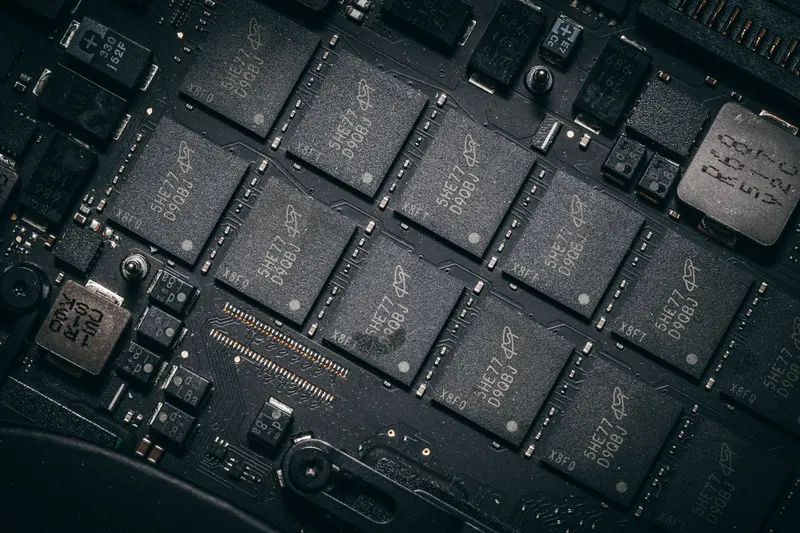
By the mid-1950s the transistor had made electronics smaller and more reliable, but a new obstacle appeared: sheer complexity. Every transistor, resistor and capacitor was a separate part, and every connection between parts was a soldered joint, usually made by hand. A computer or a missile guidance system could need hundreds of thousands of joints, and each one was a possible point of failure. Jack Morton, a Bell Labs executive, is generally credited with the label for the impasse, the "tyranny of numbers": the more components a system had, the more connections it needed, and the harder it became to keep the whole thing reliable and affordable. Morton himself doubted that packing many parts onto one chip would escape the problem, because he expected yields to collapse, and Kilby and others later used the phrase to describe the problem they set out to solve. The way out was to make the entire circuit at once, as a single object.
How it works
An integrated circuit, or chip, places the transistors and other parts of a circuit, already wired together, on one piece of semiconductor, nearly always silicon. Rather than assembling loose parts, manufacturers fabricate the circuit with chemical and optical processes applied to a thin round slice of silicon called a wafer.
The central technique is photolithography. The wafer is coated with a layer of oxide and then with a light-sensitive material. Light shines through a mask bearing the circuit pattern, and the exposed areas change their properties so that material can be selectively removed. The exposed silicon is then doped with impurities (the addition of tiny amounts of other elements that alter conductivity), and metal is deposited to form connections. The cycle repeats with dozens of successive masks, one per layer. Because one mask prints hundreds of identical chips across the wafer, the cost per chip falls as volume grows. At the end the wafer is cut apart, each die is tested, and it is packaged in a case with metal leads.
The economics follow from this. In an integrated circuit, cost does not rise in proportion to the number of transistors. Adding more transistors to the same area costs little extra as long as the manufacturing process holds up, which is why the industry kept pushing component sizes down.
Two inventions, one dispute
In mid-1958 Jack Kilby, an engineer newly hired at Texas Instruments, conceived the idea of making all the parts of a circuit from the same semiconductor material. On September 12, 1958, he demonstrated internally a simple oscillator built on a sliver of germanium. The components were in the crystal, but they were joined by fine wires attached externally, so it was a working proof of concept and still crude to manufacture. Texas Instruments filed a patent application in February 1959.
In January 1959 Robert Noyce of Fairchild Semiconductor recorded in his laboratory notebook a different approach, and Fairchild filed a patent application on July 30 of that year. His design used silicon and the planar process developed by Jean Hoerni, in which a layer of oxide protects the surface. Metal connections could then be laid down as a thin film over the oxide, with no hand-soldered wires. This route suited mass production much better. Fairchild began selling its first commercial integrated circuits in 1961, and Texas Instruments brought out competing products at about the same time.
The two companies fought over patent priority for years. Noyce's patent was granted in 1961 and Kilby's in 1964. In 1966 the companies reached a cross-licensing agreement, which in practice let both make and sell chips. The courts nonetheless kept going: in 1969 a federal appeals court sided with Noyce on priority of the key claims, and in 1970 the U.S. Supreme Court declined to review the case. Historians generally treat Kilby and Noyce as co-inventors who solved different halves of the problem, Kilby with the idea of integrating components and Noyce with a practical way to interconnect them. Kilby received a share of the 2000 Nobel Prize in Physics. Noyce died in 1990, and Nobel prizes are not awarded posthumously. As elsewhere in the history of technology, the invention also rested on chemists, metallurgists and factory technicians whose names seldom appear in the accounts.
Military and space demand
Early integrated circuits were expensive, and the customers who paid were U.S. government programs. The Apollo Guidance Computer, designed at MIT beginning in 1962, which helped navigate astronauts to the Moon, was built from Fairchild integrated circuits, each holding a pair of simple logic gates, and NASA's orders were large enough that other manufacturers were brought in as suppliers. Texas Instruments won a 1962 contract to design custom circuits for the guidance computer of the Minuteman II missile, and by 1965 that program had overtaken Apollo as the largest single buyer of integrated circuits. These projects required low weight, low power use and high reliability, and their orders helped finance the industry's learning process. As production grew, prices fell sharply during the 1960s, opening the way to civilian markets.
From chip to microprocessor
In 1965 Gordon Moore, a Fairchild co-founder who later helped start Intel, published an article in Electronics observing that the number of components on an integrated circuit had been doubling about every year and might continue to do so for some time. In 1975 he revised the pace to a doubling roughly every two years. The trend became known as Moore's law, but it is not a law of physics. It is an economic and engineering observation that the industry adopted as a planning target. Statements that it will keep holding are projections, not facts, and the pace has slowed in recent years.
Semiconductor memory emerged in the same period. Dynamic random-access memory (DRAM) stores each bit of data in one transistor and a tiny capacitor. Robert Dennard of IBM received a patent on the one-transistor cell in 1968, and Intel introduced the 1103, one of the first widely used commercial DRAM chips, in October 1970. Chip memory gradually displaced magnetic-core memory.
In 1971 Intel introduced the 4004, regarded as the first commercial microprocessor: a complete central processing unit on a single chip. It held roughly 2,300 transistors. The chip grew out of a contract with Busicom, a Japanese calculator maker. Intel's Ted Hoff proposed a general-purpose design in place of a set of custom calculator chips, Stanley Mazor helped define the architecture, Federico Faggin led the chip's design at Intel, and Masatoshi Shima, an engineer from Busicom, worked with him. Pocket calculators were one of the first mass markets for integrated circuits. Texas Instruments management challenged Kilby's group to build a handheld calculator in the late 1960s, and falling prices in the 1970s made the device common.
Impact and limitations
The integrated circuit is the material foundation of the modern computer. Processors, memories, communications controllers, sensors and medical equipment depend on it. Its effects were economic and geographic: the region south of San Francisco acquired the name Silicon Valley, and chip-making spread to several other countries.
Producing advanced chips today is a highly specialized global supply chain. As of this article's review, firms in Taiwan, South Korea, the United States and Japan are among the main manufacturers, and the most advanced lithography equipment comes from very few companies, notably one in the Netherlands. A modern fabrication plant, or fab, costs billions of dollars and needs extremely clean air, which concentrates production and makes the chain sensitive to geopolitical and logistical disruption.
There are technical limits as well. With features only a few nanometers wide, quantum effects make it harder to keep components electrically isolated, and heat per unit area climbs. Manufacturers have responded with stacked layers, new materials and designs that combine several small chips in one package. Whether these measures can sustain the past rate of improvement remains an open question.
Connections to other technologies
The integrated circuit grew out of the transistor. In turn it let computers leave specialized rooms, a theme picked up in from mechanical calculators to the first computers, and reach desktops as the personal computer. Image sensors made in silicon, descendants of the same fabrication methods, also changed photography, displacing film in most uses.