Before cellular telephony, talking by phone meant being tied to a wire. People who had to communicate on the move relied on restricted radio services, such as those of police, taxis and emergency crews, or on radiotelephone systems installed in automobiles. Such systems existed from the mid-1940s, but they ran up against a physical limit: the radio spectrum is finite. A single powerful antenna covering an entire city could handle only a handful of simultaneous calls, because each call occupied its own channel. Mass mobile telephony became possible only when engineers found a way to reuse the same frequencies in different places.
How it works
The central idea is the cell. Instead of one antenna, the service area is divided into smaller zones, each served by a base station with a low-power transmitter. Zones far enough apart can use the same frequencies without interfering, which multiplies total capacity. When a user moves from one cell to another during a call, the network hands the connection from one base station to the next, a procedure called handoff (or handover). A mobile switching center tracks the handset, routes the call and connects it to the fixed telephone network, a subject covered in the evolution of the telephone.
First-generation (1G) systems carried voice in analog form. From the 1990s, second-generation (2G) systems digitized voice, which allowed compression, encryption and more efficient use of spectrum. Later generations (3G, 4G and 5G) added capacity for data such as browsing and video through advances in modulation, the use of multiple antennas and new frequency bands. The generations are defined by sets of technical standards, not by any single device or invention.
Antecedents: radio in vehicles
On June 17, 1946, the Bell System, part of AT&T, began offering a mobile telephone service for vehicles in St. Louis, Missouri, followed by services in other cities. It used radio and relied on human operators to complete calls; the equipment was bulky and the number of channels very small. Radio communication without wires had been developed earlier, as described in radio and wireless transmission, but mobile telephony required a network architecture of its own.
Historical context
The cellular concept was worked out at Bell Laboratories, AT&T's research arm. An internal Bell Labs memo of December 1947, written by Douglas Ring and reflecting ideas developed with Rae Young, already described dividing an area into cells with frequency reuse. At that time, available technology and frequency-allocation rules made a practical system impossible, and development stretched through the 1950s and 1960s with contributions from many engineers and from studies of radio propagation and switching. The design also needed automatic computer control, which was impractical before the miniaturization discussed in integrated circuits.
On April 3, 1973, Martin Cooper of Motorola placed a demonstration call in New York from a prototype handheld phone; according to later accounts, he called a rival researcher at Bell Labs, and the prototype weighed roughly 2.5 pounds (about 1.1 kilograms). The demonstration was a milestone, but the device was a prototype, and commercial service took about a decade to arrive. There was also a corporate rivalry: Bell Labs is generally described as favoring car-mounted phones, while Motorola pushed for portable handsets.
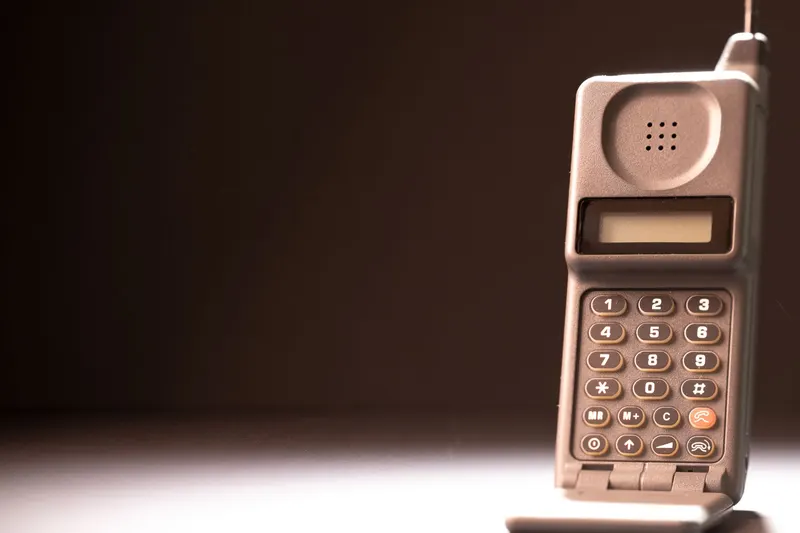
Commercial cellular service began in stages. Nippon Telegraph and Telephone (NTT) opened what is generally regarded as the first commercial cellular network, in Tokyo in December 1979. In 1981 Sweden and Norway opened NMT (Nordic Mobile Telephone), with Denmark and Finland following in 1982; it allowed use across national borders, known as roaming. In the United States, AMPS (Advanced Mobile Phone Service) began commercial operation in Chicago in October 1983, and Motorola's DynaTAC 8000X, approved by the Federal Communications Commission that September, was among the first portable handsets used on it. It was expensive and heavy, and its battery did not last long.
The second generation was marked by digitization and standardization. In Europe, GSM (originally Groupe Spécial Mobile, later Global System for Mobile Communications) saw its first commercial network open in Finland in mid-1991. The standard brought together operators and manufacturers from many countries and allowed one handset to work on many networks, with a removable card, the SIM, that stores the subscriber's identity. On December 3, 1992, according to the most widely cited accounts, the engineer Neil Papworth sent the first text message (SMS) over a commercial network, from a computer to a phone on the Vodafone network in the United Kingdom. The service, at first a side feature, became one of the most common uses of mobile phones. In 1994 BellSouth began selling the Simon, designed by IBM, a device that combined a phone with an address book and other functions, regarded as a forerunner of the smartphone.
Around the turn of the century, third-generation (3G) networks expanded data transmission, and handsets from makers such as Nokia and several Japanese and American companies began to offer cameras, email and limited Internet access. Devices such as the BlackBerry, from the Canadian company Research In Motion, paired a physical keyboard with mobile email, especially in business. On January 9, 2007, Apple announced the iPhone, with a touch screen and a full web browser, and it reached stores that June. In October 2008 the first commercial device running the Android operating system, the HTC Dream (sold by T-Mobile in the United States as the G1), went on sale. These systems established the current model of the smartphone: a small networked computer on which programs, called apps, are installed from online stores. Use of the Web on small screens, once limited, became routine.
Fourth-generation networks (4G, especially the LTE technology) saw their first commercial launches in Stockholm and Oslo in December 2009 and prioritized data traffic. Fifth-generation (5G) specifications were developed by the standards body 3GPP, which completed its first full set of 5G specifications (Release 15) in 2018, and the first commercial networks went live in a few countries, including South Korea, between late 2018 and 2019. As of this article's latest review, rollout is continuing and varies widely among countries and carriers; claims about 5G's future reach and economic effects are uncertain and are not treated here as fact.
Impact and limitations
Mobile telephony changed communication habits, commerce, banking and emergency coordination, and in many regions it reached people who never had fixed-line service. The International Telecommunication Union (ITU) tracks coverage and subscriptions, which differ sharply between urban and rural areas.
There are also costs and debates. Heavy use raises concerns about attention, privacy and the collection of location data. Manufacturing depends on minerals such as cobalt and lithium and on rare metals whose extraction has environmental and social impacts, in some cases linked to poor working conditions. Discarded devices add to electronic waste, and United Nations reports on the subject find that only a minority of e-waste is documented as formally collected and recycled. Research on possible health effects of radio-frequency exposure is carried out by health and radiation-protection bodies, which set exposure limits; their conclusions should be consulted directly. Finally, reliance on a few operating systems and app stores is under scrutiny by competition regulators.
Connections to other technologies
Mobile telephony combines the telephone with radio, the miniaturization of integrated circuits and, now, the infrastructure of the Web. Smartphones also run functions of computational intelligence, such as speech and image recognition, partly on the device and partly on remote servers.