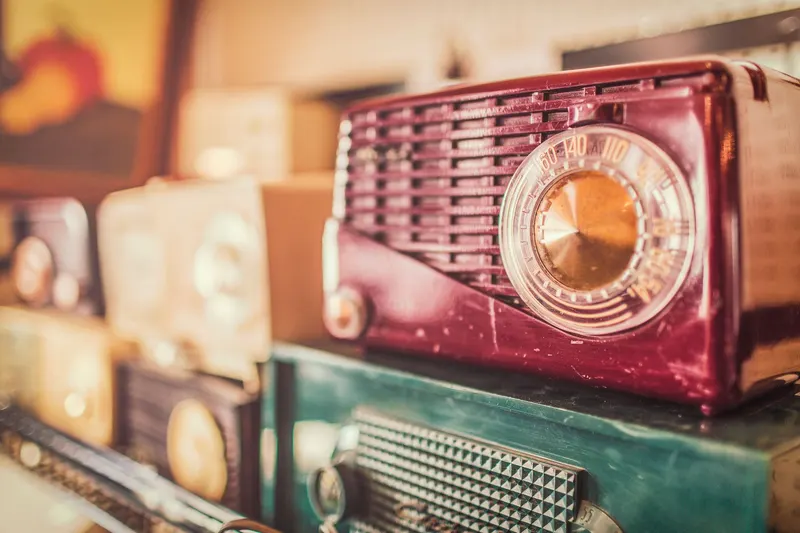
The telegraph and the telephone showed that information could travel by electricity, but they depended on wires. Lines were expensive and vulnerable, and they simply did not reach ships at sea, expeditions, or remote regions. A ship in distress had no way to call for help from anyone beyond its horizon. Wireless transmission grew up to fill that gap, first with signals of dots and dashes and later with voice and music sent to listeners the broadcaster would never identify.
How it works
Radio uses electromagnetic waves, disturbances of the electric and magnetic fields that travel through space, including a vacuum, at the speed of light. A transmitter generates an electric current that oscillates at a chosen frequency (measured in hertz, a unit named for Heinrich Hertz) and feeds it to an antenna, which radiates the wave. A receiver has another antenna, in which the wave induces a weak current, and circuits that select the desired frequency and ignore the others. This selection is called tuning.
To carry information, the wave must be modulated, meaning that some characteristic of it is varied. In wireless telegraphy, the emission is switched on and off to form Morse code. In amplitude modulation (AM), the strength of the carrier wave varies with the audio signal. In frequency modulation (FM), it is the frequency of the carrier that varies, which reduces sensitivity to amplitude noise such as that caused by thunderstorms and electrical equipment. The receiver demodulates the signal, recovering the original. Because waves of different frequencies behave differently, some are reflected by the ionosphere, a high layer of the atmosphere, and cover great distances, while others travel almost in straight lines.
Historical context
From theory to laboratory
In the 1860s, the Scottish physicist James Clerk Maxwell formulated the theory that unified electricity, magnetism, and light and predicted electromagnetic waves. Between 1886 and 1888, the German Heinrich Hertz produced and detected these waves in the laboratory, confirming the theory. Hertz saw no immediate practical use for them.
In the 1890s, several researchers explored applications. Oliver Lodge in Britain demonstrated reception and worked on tuned circuits. Jagadish Chandra Bose in Calcutta studied very short waves and developed detectors. Aleksandr Popov in Russia presented in 1895 a receiver for detecting atmospheric electrical discharges and carried out signal transmissions. Nikola Tesla filed patents for tuned-circuit systems in 1897. The Italian Guglielmo Marconi, who set up his company in the United Kingdom, applied for his first British patent on wireless telegraphy in 1896 and stood out for his commercial organization: he built stations, sold equipment to navies and shipping companies, and staged demonstrations over growing distances.
The 1901 controversy and the patents
In December 1901, Marconi reported receiving at Signal Hill, Newfoundland, the letter "S" in Morse code sent from Cornwall across the Atlantic. The feat became famous, but the reception was not confirmed by independent witnesses, and historians debate its quality, largely because nighttime propagation conditions were poorly understood at the time. In 1943, the United States Supreme Court, in a suit by the Marconi company against the U.S. government over patent infringement, held the broad claims of Marconi's 1904 patent on tuned four-circuit systems invalid, because earlier work by Lodge, John Stone Stone, and others, with Tesla's patents also discussed, had anticipated them. The ruling addressed the validity of that one patent, not who "invented radio," and the opinion itself noted that Marconi's original patent, on which his reputation rests, was not in question. The historical debate remains, since the technology resulted from accumulated contributions.
Vacuum tube, voice, and rescue
Early radio used electric sparks and crude, poorly selective detectors. In 1904, the British engineer John Ambrose Fleming patented the vacuum-tube diode, which lets current pass in only one direction and can detect signals. In 1906 and 1907, the American Lee de Forest added a third element, the grid, creating the triode (Audion), which could amplify weak signals and, later, generate stable oscillations. Vacuum tubes made more sensitive transmitters and receivers possible and allowed the transmission of voice.
Reginald Fessenden, a Canadian working in the United States, experimented with voice transmission by amplitude modulation. According to accounts, in December 1906 he transmitted speech and music from Brant Rock, Massachusetts, to ships off the coast, and the Christmas Eve date is often repeated. The details of that episode come largely from later recollections, and historians question them, so it is prudent to treat it as an important experiment rather than as the start of broadcasting.
During the first decades, radio was mainly maritime wireless telegraphy: links between ships and shore stations. In April 1912, the sinking of the Titanic showed both the value and the flaws of the system. The ship's operators called for help, and another ship, the Carpathia, responded, but there were vessels nearby without an operator on duty. After the disaster, the United States passed the Radio Act of 1912, which required licenses for stations and assigned frequency bands, and international conventions reinforced the obligation to keep a continuous emergency watch.
Broadcasting
The idea of transmitting to a scattered public, rather than to a specific recipient, took hold in the 1920s. In the United States, station KDKA of Pittsburgh, operated by Westinghouse, went on the air on 2 November 1920 with coverage of the presidential election between Warren Harding and James Cox, after receiving a license in late October. It is often cited as the first licensed commercial station, although there were experiments and earlier stations elsewhere, including in the Netherlands, Detroit, and Montreal, where the Marconi company's experimental station XWA was already broadcasting programs in 1919 and 1920. In Britain, the British Broadcasting Company began daily transmissions in 1922 and was replaced on 1 January 1927 by the British Broadcasting Corporation, a public body created by royal charter. In Brazil, demonstrations took place in 1922 during the centennial celebrations of independence, and the Rádio Sociedade do Rio de Janeiro, led by Edgard Roquette-Pinto and Henrique Morize, was founded in 1923.
In parallel, the American engineer Edwin Armstrong contributed the regenerative circuit (1912) and the superheterodyne receiver (developed in 1918), which converts the incoming frequency to a fixed, lower one that is easier to amplify and filter, a principle still in use; the French engineer Lucien Lévy also claimed priority for the superheterodyne, and the two fought over it. In the 1930s Armstrong developed FM, demonstrated in 1935, which offered higher-quality sound but faced commercial resistance and legal disputes.
Impact and limitations
Radio was the first electronic medium to reach millions of homes at the same moment, without depending on literacy. It carried news, music, sports, serial dramas, and advertising, and it helped form a shared cultural repertoire. It was also a political instrument: governments used radio to address the population and, in authoritarian regimes, for propaganda. In Nazi Germany, the production of cheap mass-market receivers widened the reach of state messages. In World War II, broadcasts served information as well as propaganda and disinformation, and radio direction finding helped locate transmitters.
Because the frequency spectrum is limited and interference is unavoidable when two stations use the same band, regulation became necessary. In the United States, the Federal Radio Commission was created in 1927 and replaced in 1934 by the Federal Communications Commission. Internationally, the International Telecommunication Union, which descends from the International Telegraph Union founded in 1865, coordinates the allocation of bands. Each country decides who receives licenses, which involves disputes over censorship, concentration of ownership, and access.
Technical limits include atmospheric noise, interference from neighboring stations, signal fading at certain hours, and the limited range of higher bands. The replacement of vacuum tubes by the transistor reduced size and power use and made receivers portable, and transistor radios went on sale from the mid-1950s.
Connections to other technologies
Radio is in part a child of the telegraph: wireless telegraphy kept Morse code and the practices of station operation. The telephone contributed microphones and the interest in transmitting the voice. Television inherited from radio modulation, tower infrastructure, frequency licensing, and the broadcaster model, and early television stations were often owned by radio groups. Mobile phones use the same physical principle, with antennas, carriers, and division of the spectrum, although with far more elaborate digital techniques and stations arranged in cellular networks. The transistor made radios small and portable.