Before cinema there was photography, which froze a single instant, and there were toys and shows that suggested movement with drawings. What did not exist was a way to record the real movement of people, animals, and cities and to show it to an assembled audience. The problem had three parts: making many photographs in very rapid sequence, having a flexible and durable base to hold them, and building a device able to project them so that the eye blends them into continuous motion. The solution did not come from one person or one place, and arguments about who came first continue.
How it works
Cinema rests on a feature of perception: when slightly different images follow one another quickly enough, the brain reads them as continuous movement. The traditional name is persistence of vision, although perception researchers still debate the exact mechanisms involved. In practice, the industry settled on about 24 frames per second for sound film, while in the silent era speeds varied, generally between about 16 and 20 frames per second, at the discretion of operators and producers.
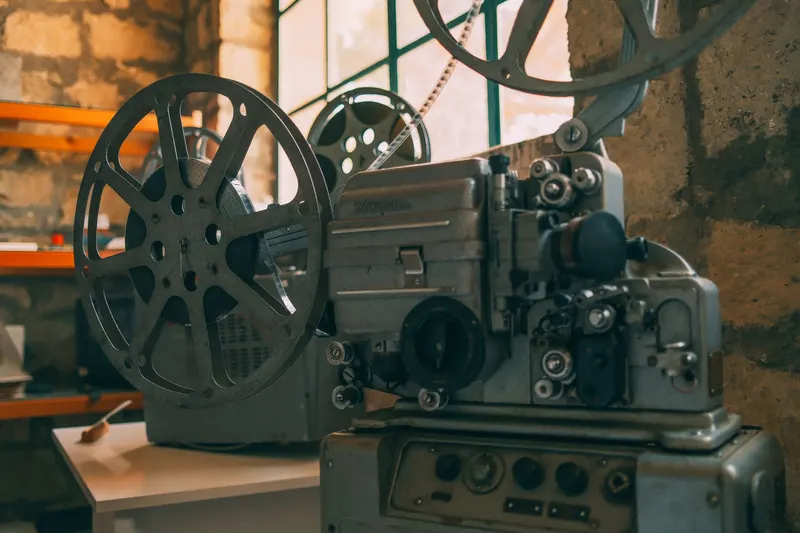
A motion-picture camera is essentially a still camera with a mechanism that advances the film frame by frame. A claw pulls the film down for a brief moment, which stops in front of the lens while a shutter (a disc with an opening) lets light through; the shutter then closes, and the claw moves the film to the next frame. The strip has perforations along the edges that guide it precisely. The projector works in reverse: a strong light passes through the frame, a lens throws it onto the screen, and a shutter blocks the light while the film advances, so the audience does not see a blur. The 35-millimeter format, established in the early years, became the international standard for decades.
Historical context
Antecedents
The magic lantern, a projector for painted glass slides used since the seventeenth century, accustomed audiences to shows of light. In the nineteenth century, toys such as the zoetrope, a rotating drum with slits and strips of drawings, demonstrated the illusion of movement. Sequential photography came later. In 1878, the photographer Eadweard Muybridge used a row of cameras triggered in succession, in California, to record phases of a galloping horse. The French physiologist Étienne-Jules Marey built around 1882 the chronophotographic gun, which captured several phases of a bird's motion on one plate or on a strip. Both men wanted to analyze movement, not to produce entertainment.
Flexible film was decisive. Once the photographic industry that George Eastman helped consolidate began supplying transparent celluloid film in rolls, in 1889, it became practical to record dozens of frames on a continuous strip. Louis Le Prince, a French inventor based in Leeds, filmed scenes in the late 1880s with a camera of his own; he disappeared under unexplained circumstances in 1890, and his work figures in priority disputes.
The Kinetoscope, the Cinématographe, and competitors
In New Jersey, Thomas Edison's team, with William Kennedy Laurie Dickson as the main technical figure, developed a camera (the Kinetograph) and a viewer for one person at a time, the Kinetoscope. Patent applications were filed in August 1891, and the device was shown publicly for the first time on May 9, 1893, at the Brooklyn Institute of Arts and Sciences. The first commercial Kinetoscope parlor opened at 1155 Broadway in New York on April 14, 1894. Viewers looked through an eyepiece, alone, at a looped film lasting well under a minute. Edison did not give priority to projection on a screen.
Projection for a paying audience took hold in 1895. In Germany, the brothers Max and Emil Skladanowsky presented their Bioscop at the Wintergarten in Berlin on 1 November 1895. In France, the brothers Auguste and Louis Lumière, owners of a photographic supply factory in Lyon, patented in February 1895 (on the 13th) the Cinématographe, a light device that served as camera, printer, and projector. The first public screening with paid admission took place on 28 December 1895, in the basement salon of the Grand Café in Paris, with short films such as workers leaving the Lumière factory. In England, Robert W. Paul built a projector in 1896, and William Friese-Greene, who did important experiments, is the subject of debate about how far his results went. In the United States, projectors such as the Vitascope were shown to audiences in 1896 with Edison's name attached, though the machine was developed by others.
For these reasons, historians generally avoid the phrase "the inventor of cinema." They speak instead of a group of inventors, with different dates and criteria: who recorded first, who projected first, who exhibited commercially first. The date of 28 December 1895 is widely used as the landmark of commercial exhibition to a paying public, but it does not settle the discussion.
From attraction to language
In the first years, cinema was a fairground and music-hall attraction. Georges Méliès, a French illusionist, built films with camera tricks such as substitutions, dissolves, and painted sets; A Trip to the Moon (1902) is his best-known title. Edwin S. Porter in the United States and other filmmakers explored editing, changes of shot, and storytelling. Studios, distributors, and permanent theaters gradually formed an industry centered in France, the United States, and Italy, among other countries.
Sound and color
"Silent" cinema was never silent: screenings had live musicians, narrators, or sound effects. Mechanical synchronization of a disc with the image was the route chosen by Warner Bros. with the Vitaphone system, used in Don Juan (1926), which had a recorded musical score. The Jazz Singer (1927) had synchronized speech and songs in parts and helped drive the adoption of sound. The disc system, however, suffered from synchronization problems. Sound-on-film, in which the soundtrack is recorded as a band of varying light beside the pictures and read by a photoelectric cell in the projector, eventually prevailed; its systems included Movietone and Lee de Forest's Phonofilm.
Color was at first applied by hand or by tinting. The Technicolor company's process went through stages: a two-color system from the 1910s and 1920s and, from 1932, the three-strip system, which recorded red, green, and blue on three separate negatives. Becky Sharp (1935) was the first feature-length film made in full three-strip Technicolor.
Impact and limitations
Cinema created a mass audience, unprecedented for moving images, and became a medium of entertainment, information, propaganda, and documentation. Newsreels brought distant events into theaters; film was also an instrument of governments and parties, especially in the 1930s and 1940s. The language of editing and shot composition influenced the visual arts, advertising, and, later, television.
The production infrastructure required capital, which concentrated power in studios. The transition to sound, for example, made production more expensive and pushed smaller exhibitors to invest in equipment.
There are also problems of preservation. Cellulose nitrate film, used until the early 1950s, is flammable and decomposes over time, and handling it called for care; acetate "safety" film replaced it, but it too suffers from degradation. Many films were lost to fires, disposal, or neglect, and recycling of silver also destroyed prints. A study by the film historian David Pierce, published in 2013 for the National Film Preservation Board of the Library of Congress, found that only about 14 percent of American silent feature films made between 1912 and 1929 survive as complete works on their original 35-millimeter format, with another 11 percent surviving in full-length foreign versions or in lesser formats such as 16-millimeter, which leaves most of the output with no surviving copy of either kind. In Brazil, institutions such as the Cinemateca Brasileira and the Museu da Imagem e do Som work on the custody and restoration of collections.
Connections to other technologies
Cinema is a direct heir of photography: it uses the same silver-salt chemistry on a flexible base, and the idea of sequencing images came out of the studies of Muybridge and Marey. Synchronized sound tied cinema to sound recording, which supplied microphones and amplifiers. Television revived moving images by electronic means, and it came to compete for audiences and to draw on films for its programming, while radio anticipated the model of broadcasting to the public at home.