Until the middle of the nineteenth century, sound vanished the moment it occurred. A piece of music existed only while it was played; a voice, only while it was heard. What could be preserved were instructions for producing sound again, such as musical scores and written descriptions. Inventors and scientists began to ask whether the air vibrations of speech could leave a physical mark that could later be read back. The answer took several attempts, one of which succeeded at first only as a visual record, and then more than a century of changes in the medium, from wax to plastic discs to computer files.
How it works
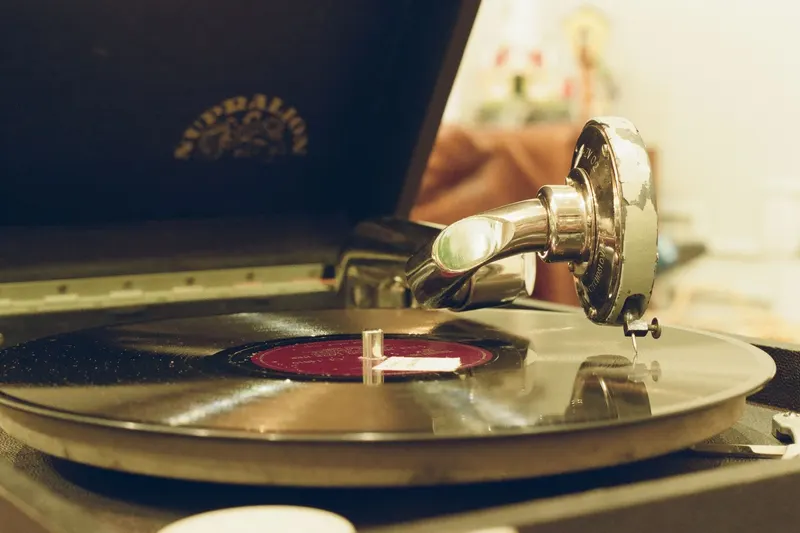
Every sound recording system converts a vibration into something that can be stored and then runs the process in reverse. Sound is a rapid variation in air pressure. In acoustic recording, a large horn concentrated that variation onto a thin diaphragm, which moved a stylus able to cut or scratch a moving surface. On playback the process was reversed: a stylus followed the groove, the diaphragm vibrated, and the horn amplified the sound.
In electrical recording, a microphone converts air pressure into an electrical current, which can be amplified by vacuum tubes before it reaches the cutting device. In magnetic recording, that current flows through a coil (the head), which magnetizes particles in a coating on tape according to the signal; on playback, the moving tape induces a current in the head. In digital recording, the signal is measured thousands of times per second (called sampling) and each measurement is stored as a number. The compact disc, for example, uses 44,100 samples per second and 16 bits per sample, per channel.
Historical context
Recording without playback
In 1857, the French typesetter and inventor Édouard-Léon Scott de Martinville patented the phonautograph. A diaphragm moved a bristle that traced a wavy line on paper blackened with lamp soot. The device was not designed to play sound back; it was meant as a kind of acoustic shorthand for studying speech visually. In 2008, researchers of the First Sounds collaborative, working with scientists at the Lawrence Berkeley National Laboratory, used optical scanning and digital processing to convert a phonautogram made on 9 April 1860, of a French folk song, into audible sound. It is the earliest known recording of a human voice that has been played back, and it shows that the information survived in the traces.
The phonograph and the disc
In 1877, Thomas Edison's laboratory at Menlo Park, New Jersey, unveiled the phonograph, which indented a groove in tinfoil wrapped around a cylinder and played it back; the first recording is usually dated to December 1877 and the patent was issued in February 1878. For the first time, a recorded voice could be heard again. The tinfoil records were fragile and short-lived. In the 1880s, the Volta Laboratory, established by Alexander Graham Bell with Chichester Bell and Charles Sumner Tainter, developed the graphophone, which used wax-coated cylinders for more durable recordings. Edison also adopted wax in the following years.
The German immigrant Emile Berliner bet on a different format. He patented the gramophone in 1887, which recorded a lateral groove on a flat disc. The great advantage was that discs could be mass-produced from a master, while cylinders were at first much harder to duplicate. By the early twentieth century, the shellac disc, turning at roughly 78 revolutions per minute (a speed standardized later), dominated the market. It held only a few minutes per side, which shaped the length of popular songs for decades.
Microphone, amplifier, and tape
In 1925, the record companies Victor and Columbia began using the electrical recording system developed by Western Electric, the manufacturing arm of the Bell System, on the basis of research at Bell Laboratories. The microphone and vacuum-tube amplifier widened the range of frequencies captured and allowed orchestras and distant singers to be recorded better. The process was tied to telephone research, and telephone technology supplied the basis for these microphones.
Magnetic recording began with the Danish engineer Valdemar Poulsen, who patented the telegraphone in 1898; it recorded magnetic signals on steel wire. In the 1930s the German company AEG, with the chemical firm BASF, developed the Magnetophon, which used plastic tape coated with iron oxide. High-frequency bias, a technique that greatly improved fidelity, had been patented earlier elsewhere, and German engineers refined and rediscovered its use around 1940, so credit for it is shared among several people. After World War II, Magnetophon machines were brought to the United States, where the engineer Jack Mullin and companies such as Ampex helped turn them into commercial products. Tape allowed re-recording, cutting, and splicing, and it opened the way to multitrack recording.
Consumer formats
In 1948, Columbia introduced the LP (long-playing) record, which turned at 33⅓ revolutions per minute, was made of vinyl with finer grooves, and held roughly twenty minutes per side. In 1949, RCA Victor answered with a 7-inch disc at 45 revolutions. This so-called war of the speeds ended with both formats coexisting. Stereophonic sound, based on theoretical work by the British engineer Alan Blumlein in the early 1930s, reached commercial discs in the late 1950s.
In 1963, Philips presented the compact cassette, a tape in a small case, at first aimed at dictation and later adapted for music. With it, and later with portable players, ordinary people could record and copy. The compact disc (CD), developed jointly by Philips and Sony, reached the market in 1982 in Japan, followed by Europe and the United States in 1983, with laser reading and digital sound.
The MP3 grew out of research on audio compression based on psychoacoustics, the study of what the human ear does and does not perceive. Work at the University of Erlangen-Nuremberg and the German Fraunhofer Institute, in which the engineer Karlheinz Brandenburg played a leading part, built on earlier ideas by Dieter Seitzer. The resulting method became Layer III of the MPEG-1 audio standard, which was approved in 1992 and published as an international standard in 1993; the ".mp3" file extension followed in 1995. Compression shrinks files by discarding information that tends to go unnoticed, and, combined with the spread of the internet, it changed how music circulated.
Impact and limitations
Recording created the record industry: labels, artists known through discs, radio playing recorded music, regional imprints. It also changed music itself. Musicians now had a fixed version of a performance that could be studied and imitated; the length of a track adjusted to the medium; studios became instruments of creation, with editing, overdubbing, and effects. In the second half of the twentieth century, practices such as sampling, which reuses fragments of existing recordings, produced new genres and also legal disputes over copyright.
Recordings also mattered for research: ethnomusicologists, linguists, and historians began to preserve voices, languages, and music of communities, and sound archives became sources of study. In Brazil, commercial recordings made in the first years of the twentieth century preserved popular genres, although what got recorded followed the interests of the companies that made the discs.
Technical limitations vary with the medium. Shellac discs are brittle and produce surface noise. Vinyl wears with playing and suffers from dust and scratches. Magnetic tape loses quality with each copy, accumulates hiss, and can deteriorate over time, partly through breakdown of the binder that holds the oxide. Digital formats avoid generational loss, but they depend on equipment and software that can become obsolete, and the MP3 discards information when it compresses. Preserving sound collections therefore requires periodic migration to new media.
Connections to other technologies
Sound recording crossed paths with several other techniques. Radio came to depend on discs and later tapes, while microphone and amplification techniques came from telephone and vacuum-tube research. Cinema added sound in the 1920s, first with synchronized discs and then with a soundtrack printed on the film itself. The miniaturization of portable devices owes much to the transistor, which replaced vacuum tubes in amplifiers and players. Finally, the idea that a wave can be measured and stored as numbers links the CD to the rest of digital electronics.