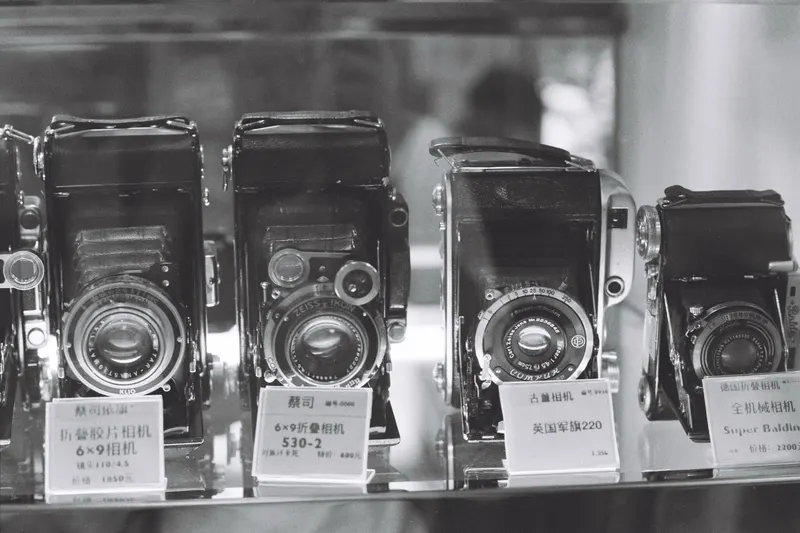
For centuries, anyone who wanted to keep the appearance of a person, a landscape, or an object depended on the hand of a draftsman or painter. The result carried the skill, the interpretation, and the working time of the artist. Yet an optical effect had been known for a long time: when light enters a dark room through a small hole, the scene outside appears projected, upside down, on the opposite wall. What was missing was a way to make that image stay. Photography emerged when the optics of that projection met the chemistry of light-sensitive substances, and the record stopped being solely the work of a hand.
How it works
Every photographic camera combines two elements. The first is the camera obscura (Latin for "dark chamber"): a closed box with an opening through which light enters and forms an image on the far side. The scholar Ibn al-Haytham, known in Europe as Alhazen, analyzed the principle in his Book of Optics, written in the early eleventh century. Renaissance artists later used portable versions fitted with lenses to help with drawing. The second element is a sensitive material, a surface whose chemical composition changes when light strikes it.
Silver salts became the basis of most nineteenth- and twentieth-century photography. Compounds such as silver chloride and silver bromide darken when exposed to light. Between exposure and finished picture, however, there are several steps. The exposure produces a latent image, still invisible; a chemical developer amplifies the effect until the image appears; and a fixer removes the silver salt that light did not reach, so the picture does not darken completely the next time it is exposed to light. John Herschel, the English astronomer and chemist, reported in 1819 that sodium thiosulfate (then called hyposulfite of soda) dissolves silver salts. In 1839 he told Talbot and others about its use for fixing, and it soon displaced the common-salt and other fixing baths used in the earliest processes. Herschel also helped popularize the words "photography," "negative," and "positive," although he was not the first person to use "photography."
Processes differ in how the image is obtained. In a negative, the bright areas of the scene come out dark, and many paper prints can be made from it. In direct-image processes, the exposed plate is itself the picture, and it is unique.
Historical context
The first experiments
The French inventor Nicéphore Niépce worked for years with light-sensitive materials. His best-known surviving picture, made around 1826 or 1827, shows the rooftops visible from his window at Le Gras, near Saint-Loup-de-Varennes. It was made on a pewter plate coated with bitumen of Judea, an asphalt that hardens where light strikes it, and the exposure was very long; older accounts say about eight hours, while later studies suggest it may have been longer. Niépce called his processes heliography, "sun writing." The plate is held at the Harry Ransom Center of the University of Texas at Austin.
Niépce partnered with Louis Daguerre, a painter and showman who staged light-and-illusion spectacles. After Niépce died in 1833, Daguerre continued the research and developed the daguerreotype: a silver-coated copper plate, sensitized with iodine vapor, exposed in the camera, and developed with mercury vapor. The result was a unique, sharp image with a mirror-like surface. The process was announced at the Paris Academy of Sciences in January 1839. In August 1839 its technical details were published, after the French government acquired the rights and offered the process to the world, with the exception of Britain, where Daguerre had patented it a few days earlier.
A field of many inventors
The story of the daguerreotype often overshadows other paths. The Englishman William Henry Fox Talbot developed "photogenic drawing" and then the calotype, patented in 1841, a paper-based process: a paper negative from which many positive prints could be made. The picture was softer than a daguerreotype's, but the negative-positive principle defined photography in the following century. Hippolyte Bayard, a French civil servant, produced direct positive images on paper and exhibited them in 1839. Anna Atkins, a British botanist, used the cyanotype process, invented by Herschel, to illustrate books on algae from 1843 onward.
In Brazil, the French-born Hercule Florence, who lived in Campinas, experimented in the early 1830s with paper sensitized with silver salts and used the word "photographie" in his manuscripts. The question of priority is debated. The Brazilian researcher Boris Kossoy studied Florence's papers in the 1970s and argued for the importance of his work, but there is no consensus on how to compare it with the processes announced in Europe, which were published and widely replicated while Florence's remained little known. The Instituto Moreira Salles in São Paulo holds a print dated 1833 that it presents as an early photographic record made in the Americas with silver salts. In any case, the episode shows that several people, in different places, were trying to solve the same problem at the same time.
From collodion to gelatin
In 1851, the English sculptor Frederick Scott Archer published the wet collodion process: a glass plate coated with collodion (a sticky solution) and silver salts, which had to be exposed and developed while still wet. Photographers had to carry a portable darkroom into the field. In return, images were sharper and exposures shorter, and glass negatives could yield many paper prints.
In the 1870s, the gelatin dry plate made it possible to prepare plates in factories, store them, and develop them later. The English physician Richard Leach Maddox published the basic idea in 1871, using gelatin as the medium for silver salts, and others improved it in the following years. This separated the person who took the photograph from the person who prepared the materials and opened the way to industrial production of photographic supplies.
The next step was taken by the American George Eastman. In 1888, his company introduced the Kodak camera, preloaded with a roll of film for about one hundred exposures. When the roll was finished, the owner sent the whole camera back to the company, which developed the pictures and returned the camera reloaded. Transparent, flexible celluloid film replaced the paper-based film shortly afterward. From then on, photography became accessible to amateurs who knew nothing of the chemistry behind it.
Impact and limitations
The new record had immediate uses. The portrait, once restricted to those who could pay a painter, became available to much wider parts of the population. Science adopted photography to record phenomena: John William Draper made a daguerreotype of the Moon in 1840, and observatories began accumulating photographic plates of the sky that could be measured and compared over decades. Physicians, botanists, and archaeologists documented their subjects. Roger Fenton photographed the Crimean War in the mid-1850s, and in the following decade teams including those of Mathew Brady and Alexander Gardner recorded the American Civil War. In courts and police work, photographs came to serve as evidence and identification.
The limitations were significant. Early exposures required minutes of stillness, which made movement hard to photograph and gives many early portraits a stiff look. Daguerreotypes were single objects, with no negative for reproduction. The chemicals were toxic, and mercury vapor exposed operators to risk. Because of the long exposures, nineteenth-century war photographs show mostly landscapes, battlefields after the fighting, and posed portraits rather than action.
Photography has also never been a neutral mirror. Choice of framing, lighting, and moment, staging, retouching of negatives, and the combining of images all existed in the nineteenth century. Whether a photograph proves something depends on who took it, who captioned it, and who published it. Access was unequal as well: for much of the century, equipment and supplies were expensive, and the people able to photograph, and to be photographed with dignity, were a small part of society. Later, color film stock was calibrated to render some skin tones well, which drew criticism of the bias built into the technique.
Connections to other technologies
Photography supplied the visual foundation for other techniques. By photographing sequences of motion, Eadweard Muybridge and Étienne-Jules Marey prepared the way for cinema, which is in essence a rapid series of photographs projected to an audience. Electronic television also inherited the vocabulary of framing and contrast from photography, although it relies on different physical principles. The relationship to sound recording is less direct but notable: both fields fostered the idea that fleeting phenomena, such as an image or a voice, can be stored and reproduced.
Digital photography replaced silver with an electronic sensor. The CCD (charge-coupled device) was invented in 1969 by Willard Boyle and George Smith at Bell Laboratories, and they shared the 2009 Nobel Prize in Physics for it with Charles Kao, who was honored for work on optical fibers. Such sensors depend on the miniaturization of electronics described in integrated circuits. A prototype digital camera was built at Kodak by Steven Sasson in 1975, and consumer digital cameras began selling in volume in the 1990s.