Radio made it possible to hear distant events; cinema showed moving images but required theaters, prints, and the transport of film. Sending moving images as a signal, to receivers at home and at the moment they happened, was a different problem. An image holds far more information than a sound: the scene must be broken into elements, sent in order many times per second, and rebuilt in step at the receiver. Tackling that problem took decades of work in optics, electronics, patents, and regulation.
How it works
Television is based on scanning: the image is divided into lines, and each line into points of brightness, sent one after another. If the process is repeated fast enough, the eye sees a complete moving picture. A synchronization signal tells the receiver when each line and each frame begins.
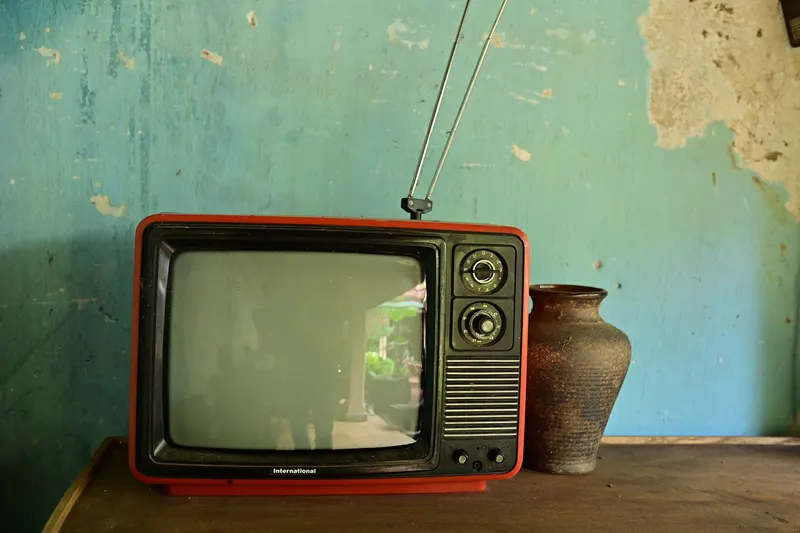
In the mechanical system, a disc with holes arranged in a spiral turned in front of the scene, and each hole swept one line. A light sensor converted brightness into current, which was sent to a receiver with a synchronized disc. The disc limited resolution and image size. In the electronic system there are no moving parts for scanning. In the camera, a pickup tube (such as the iconoscope) converts the image into electric charge and an electron beam reads it line by line. In the receiver, the cathode-ray tube (CRT) fires a beam of electrons at a screen coated with phosphor, which glows where the beam strikes; coils deflect the beam so that it sweeps the screen. For color, the receiver uses three kinds of glowing dots (red, green, and blue), and a metal mask makes each beam hit only its matching dot.
Historical context
Mechanical antecedents
In 1884, the German Paul Nipkow applied for a patent on a scanning system with a disc perforated in a spiral, the Nipkow disc. There is no evidence that he built a working apparatus at the time, but the idea guided many later experiments. In the 1920s, the Scot John Logie Baird demonstrated images transmitted by mechanical systems in London, including a showing to members of the Royal Institution in January 1926. In the United States, Charles Francis Jenkins also worked on mechanical systems. These images had few lines and little sharpness, but they showed that transmitting moving pictures was possible.
The transition to electronics
Electronics took over the scanning on several fronts. In Russia, Boris Rosing had proposed, in the first decade of the century, using a cathode-ray tube for reception. The Hungarian Kálmán Tihanyi and the Japanese Kenjiro Takayanagi, among others, also contributed. In the United States, Vladimir Zworykin, a Russian immigrant who worked at Westinghouse and later at RCA, filed a patent application in 1923 related to the iconoscope, and in the 1930s RCA, under David Sarnoff, invested heavily in its development. Philo Farnsworth, a self-taught inventor, transmitted a first image with an all-electronic image dissector in San Francisco in September 1927 and showed the system to the press in 1928, and his company entered a patent dispute with RCA. In September 1939, RCA settled by agreeing to pay Farnsworth's company a license fee reported at one million dollars over ten years, plus royalties, the first time RCA had agreed to pay royalties to an outside inventor. This is seen as recognition of his priority on specific technical points, although the final commercial system resulted from the contributions of many engineers.
Regular services
The BBC describes its service, which began from Alexandra Palace in London on 2 November 1936, as the world's first regular high-definition television service. The claim depends on what counts as "high definition" and "regular": Baird's 30-line mechanical transmissions had been broadcast by the BBC from 1932 until 1935, and Germany had begun a regular service from Berlin in March 1935, at lower definition. For a few months, the BBC alternated Baird's 240-line system, which still relied on mechanical scanning, with the electronic 405-line system of Marconi-EMI, and the electronic system was adopted definitively in February 1937. In Germany, the 1936 Berlin Olympic Games were followed in public viewing rooms, which served as a technical and propaganda demonstration. World War II interrupted or reduced services in Europe, and the most intense commercial development came afterward, mainly in the United States, Europe, and Japan.
Standards and color
Because each country set its own parameters, different standards emerged. NTSC, in the United States, was established for black and white with 525 lines in 1941, with commercial service allowed from July of that year, and for color, compatible with existing sets, in December 1953. (An earlier, incompatible color system had been approved in 1950 and was withdrawn.) PAL, developed by Walter Bruch at Telefunken, and the French SECAM entered service in several European nations in 1967. The incompatibility of standards made program exchange difficult and required conversions.
Transmission over distance
The television signal travels in line of sight, which limits its range. To cover distances, engineers used microwave links and coaxial cables and later satellites. Telstar 1, launched in 1962, allowed experimental transatlantic transmissions, and geostationary satellites such as Early Bird (1965) made intercontinental links more regular. Cable television, which arose in the United States in the late 1940s to bring signals to communities with poor reception, evolved into a service with its own channels. Coverage of major events, such as the Moon landing in July 1969, consolidated the image of a simultaneous global audience, although limited to countries with the necessary infrastructure.
Brazil
The first Brazilian station, TV Tupi of São Paulo (call sign PRF-3-TV), was inaugurated on 18 September 1950 by the businessman Assis Chateaubriand, owner of the Diários Associados newspaper group, who imported equipment from the United States. In the following years, stations appeared in Rio de Janeiro and other cities. Color broadcasts began in 1972, and the country adopted a variant of PAL known as PAL-M. Brazilian digital terrestrial television, based on the Japanese ISDB-T standard with modifications, began in São Paulo in December 2007, and the switch from analog to digital signals proceeded in stages in the following years.
Impact and limitations
Television became the most influential communication medium of part of the twentieth century. It reorganized household routines, advertising, and consumption, since advertisers found in it a channel of very wide reach. In politics, candidates and governments came to depend on image and screen time. Live coverage of wars, disasters, and sporting events created new forms of witness and spectacle, and also raised questions about selection, framing, and sensationalism. Research on the effects of television on attention, children, and public debate continues, with mixed results and open scientific debate.
The technical limitations were great: few channels per region, dependence on towers and antennas, pictures subject to noise and "ghosts" from reflected signals, and bulky, heavy screens. The radio-frequency spectrum is finite, and its allocation depends on licenses and political decisions. Receivers were expensive at first, which limited access to higher-income families.
High definition and digital broadcasting, developed from the 1980s and 1990s, replaced the analog signal with coded and compressed information, which allows more channels in the same band and sharper images. Flat screens, liquid-crystal displays (LCD) and other types, replaced the CRT in home sets during the 2000s. Internet video services have since competed for audiences; as of this article's review date, broadcast television and streaming platforms coexist, with shares that vary from country to country.
Connections to other technologies
Television depends on radio for modulation, propagation, and spectrum regulation, and on cinema and photography for its visual language and much of its early content. Transistor receivers and later integrated circuits made sets smaller, cheaper, and more reliable, and the processors in modern sets decode compressed digital video. The idea of recording the signal on tape, with the videotape recorders introduced in the 1950s, brought television closer to magnetic recording, as described in sound recording.