The telegraph had shortened distances, but it carried codes. A trained operator had to encode and decode every message, and service was billed by the word. Anyone who wanted to talk to a person far away had to write a telegram and wait for the reply. The problem that led to the telephone was how to transmit the human voice directly, with its variations in pitch and tone, so that anyone could speak without training in a code.
The history of the telephone is also a classic case of disputed priority. Several researchers were working at the same time on neighboring problems, and patent records, notebooks, and lawsuits show a picture more complicated than the image of a single inventor.
How it works
Sound is a variation in air pressure. A telephone converts that variation into an electric current that fluctuates in step with it and, at the other end, converts the current back into sound.
The transmitter
In early devices, a thin diaphragm vibrated with the voice, and its motion altered the current in a circuit. On March 10, 1876, Alexander Graham Bell and his assistant used a transmitter in which a needle attached to a diaphragm dipped into a conducting liquid, so that the voice varied the electrical resistance in the circuit. Bell's patent also described an electromagnetic design: a metal diaphragm vibrating in front of an electromagnet, which generated small currents. That produced weak signals, suited to short distances.
A better solution came with the carbon microphone: granules of carbon between contacts are squeezed and loosened by the vibrating diaphragm, changing the electrical resistance and therefore the current supplied by a battery. Thomas Edison developed a carbon transmitter in 1877 and 1878, and Emile Berliner had filed for a loose-contact microphone in 1877. David Edward Hughes also developed a microphone in 1878, and it was he who popularized that name. The stronger signal made longer lines practical.
The receiver and the line
In the receiver, the current passes through an electromagnet that pulls on and releases an iron diaphragm, reproducing the original vibrations. Between the two instruments is the line, at first a pair of wires. For many users to talk to many others, a switching exchange is needed, a place where the lines of two subscribers are connected for a call.
Historical context
Antecedents and disputes
In 1861, the German teacher Philipp Reis demonstrated in Frankfurt a device that transmitted sounds, including music, and coined the word Telephon. It reproduced tones well, but clear speech only with difficulty, and historians debate how close he came to a workable telephone.
Alexander Graham Bell was a teacher of speech and of deaf students in Boston. He was working on a multiple telegraph and on voice transmission, financed by Gardiner Hubbard and helped by the mechanic Thomas Watson. The application was filed on February 14, 1876, and U.S. Patent No. 174,465 was issued on March 7, 1876. Bell and Watson transmitted speech in their laboratory on March 10. On the same day Bell's application was filed, a few hours later by most accounts, the Chicago inventor Elisha Gray filed a caveat, a document announcing an intention to patent an invention, describing a liquid transmitter. Historians have long argued, and courts once heard, about the order and content of these filings. Bell's patent was upheld in years of litigation.
Antonio Meucci, an Italian immigrant in New York, had experimented with wired voice communication since the 1850s and filed a caveat in 1871 that he renewed for a few years before it lapsed for lack of funds. In 2002, the U.S. House of Representatives passed a resolution recognizing his contributions. The meaning of that recognition is debated: it did not overturn Bell's patent, and historians disagree about how far Meucci's devices transmitted voice in a practical way.
Bell showed his telephone at the Centennial Exposition in Philadelphia in 1876, where visitors included the emperor of Brazil, Dom Pedro II. The telephone reached Brazil within a few years: the first lines, linking government offices in Rio de Janeiro, were installed in 1877, and a commercial telephone company was licensed there in 1881.
From curiosity to service
The Bell Telephone Company was organized in 1877. The District Telephone Company of New Haven opened an exchange in January 1878, widely cited as the first commercial telephone exchange. The exchanges were manual: operators took the subscriber's request and physically connected the cables with plugs. The first operators were often boys, who proved unreliable on the job, and they were replaced by young women, who came to dominate the work. In big cities, entire rooms were devoted to it. The American Telephone and Telegraph Company (AT&T) was formed in 1885 to build and run long-distance lines.
Automation
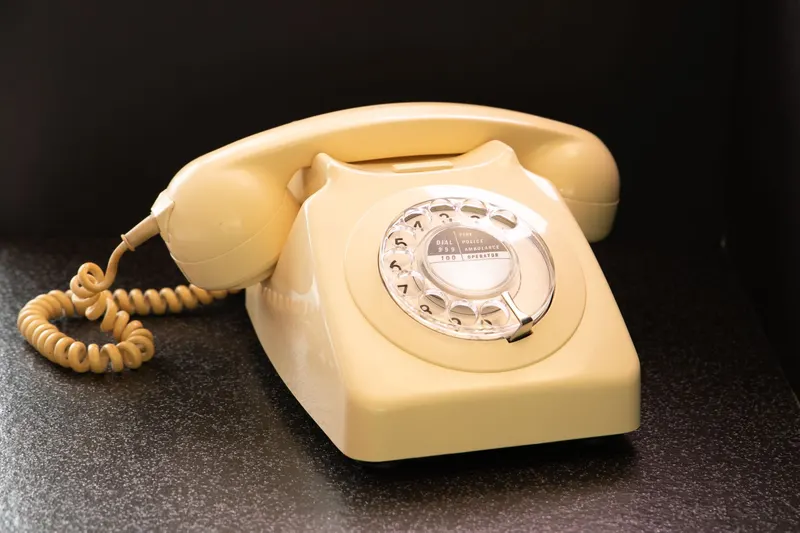
Almon Strowger, a funeral director in Kansas City, Missouri, patented an automatic switching system in 1891. The first commercial automatic exchange opened in La Porte, Indiana, in 1892. The caller dialed, and electrical pulses moved electromechanical selectors that found the requested line. The rotary dial spread in later decades. Tone dialing, marketed as Touch-Tone by the Bell System, was introduced commercially in 1963, allowing faster call setup and new services.
Impact and limitations
The telephone changed commerce, government, medicine, and social life. It made it possible to arrange meetings, call for help, and manage businesses from afar, and it influenced architecture by supporting multistory office work. Growth in cities was rapid, but unequal access left rural areas and low-income households without a line for a long time.
A central issue was how the industry was organized. Because of its network character, telephone service tended toward monopoly, and in many countries it was run by state-owned companies. In the United States, AT&T held a dominant position for decades under regulation, until a 1982 court settlement led to the breakup of the Bell System into regional companies in 1984. Elsewhere, models of concession and privatization varied. Brazil, for instance, restructured its telephone sector in the 1990s.
Privacy was also at issue, since calls could be overheard by operators or, later, intercepted. The telephone also required both parties to be available at the same moment, a limit later softened by answering machines and voicemail.
Technical growth of the network
On long lines, the problem was signal loss. Inductive loading coils and vacuum-tube amplifiers made a coast-to-coast line in the United States possible; it was opened with a ceremonial call between Bell in New York and Watson in San Francisco in January 1915. Coaxial cables, which carry many simultaneous conversations by multiplexing (sending several signals over the same medium), were used on intercity routes from the late 1930s and 1940s. The first transatlantic telephone cable, TAT-1, entered service in 1956. In 1962, the Telstar satellite, the product of cooperation among companies and agencies, relayed television and telephone signals across the Atlantic. Bell Laboratories played a central role in many of these advances, including the transistor, created there in 1947.
Digitization
Pulse-code modulation (PCM), conceived by Alec Reeves in 1937, turns the voice into numbers: the signal is measured thousands of times per second and each measurement is encoded as bits. Because numbers can be regenerated without accumulating noise, digital transmission proved more reliable. Bell System engineers introduced the T1 carrier system in the early 1960s, carrying 24 voice channels on two pairs of wires, and electronic digital switches followed from the 1970s. Optical fiber, which carries signals as light, began commercial use in the late 1970s, and TAT-8, the first transatlantic fiber-optic cable, entered service in 1988.
Connections to other technologies
The telephone descends from the telegraph, and the two networks shared wires, poles, and companies for a long time. Digital switching and bit transmission provided the technical basis for the first computer networks, which often ran over telephone lines. The idea of carrying voice without wires developed with radio and matured in mobile phones, where the handset connects to the network by radio waves.