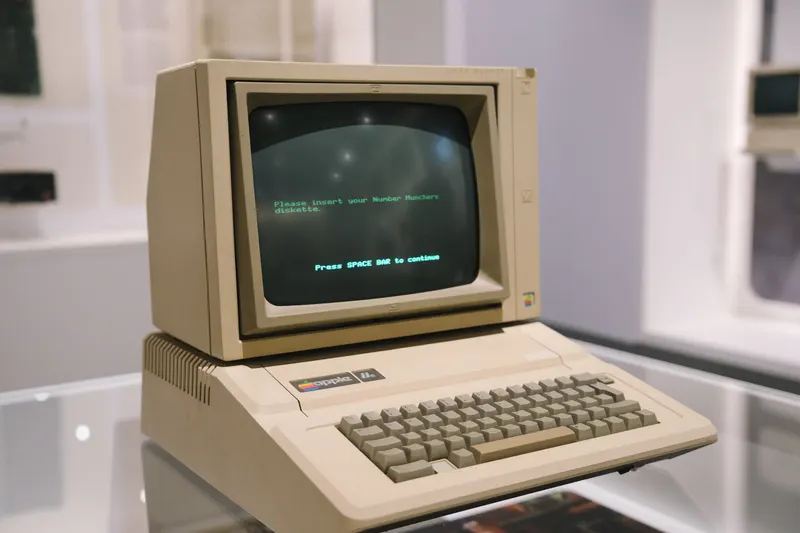
Until the early 1970s, computers were expensive machines housed in the data centers of companies, universities and government agencies. Someone who needed a calculation handed punched cards to an operator and came back hours later for the printout. Even minicomputers, smaller and cheaper than mainframes, cost tens of thousands of dollars, about the price of a house or several automobiles, and served laboratories or departments, not individuals. The problem to solve was twofold: bring the price of the equipment down to something an individual could afford, and make it usable by people who were not specialists. The spread of the personal computer resulted from changes in electronics, from communities of enthusiasts, from commercial decisions and from advances in interfaces.
How it works
The element that made the change possible was the microprocessor: the central processing unit, which carries out the instructions of a program, gathered onto a single integrated circuit (see integrated circuits). In 1971 Intel released the 4004, designed for calculators, with contributions from engineers such as Federico Faggin, Marcian "Ted" Hoff and Stanley Mazor, and from staff of the Japanese company Busicom, the project's customer. The more capable 8080 followed in 1974 and was used in many early microcomputers.
A typical personal computer combines such a processor with memory that holds the programs and data in use, storage devices (cassette tapes, floppy disks and later hard drives), a keyboard for input, and a screen or an ordinary television for output. The operating system is the program that manages these resources and provides an environment in which other programs run. When a programming language is built in, users can write their own programs, which mattered a great deal in the early years.
Antecedents and the first microcomputers
Before there was a market, there were prototypes and isolated experiments. The Kenbak-1, designed by John Blankenbaker and first sold in 1971, is often cited as the first commercially sold personal computer; a Computer History Museum contest in 1986 named it the winner of that title. The company sold only about 40 units, and the machine, with 256 bytes of memory, was programmed with switches and lights. In France, the Micral N of 1973, designed by François Gernelle and André Truong Trong Thi for process-control work, used the Intel 8008 processor and was judged in the same contest to be the first personal computer built around a microprocessor. In parallel, the Xerox Palo Alto Research Center (Xerox PARC) built the Alto from 1973, a computer for individual use with a graphical display, a mouse and a local network. It was not marketed as an ordinary product, and only a limited number were built, mostly for use inside Xerox and at a few universities, but it influenced what came after.
The event usually taken as the popular starting point was the January 1975 cover of Popular Electronics, which featured the Altair 8800, sold as a kit by Ed Roberts's company MITS in New Mexico. It was a box with switches and lights, with no keyboard or screen, yet it drew a flood of orders in the weeks after the issue appeared. Paul Allen and Bill Gates wrote a version of the BASIC language for it, which led to the founding of Microsoft later that year. In March 1975 the Homebrew Computer Club began meeting in California, where enthusiasts traded circuits, programs and ideas. Projects that came out of that milieu included Steve Wozniak's Apple I, shown in 1976, and the Apple II, unveiled at the West Coast Computer Faire in April 1977 as a finished product with a keyboard and color video output.
The same year, two other machines reached the general public: the Commodore PET, announced in January 1977 and sold from mid-year, and the TRS-80, introduced in August 1977 and sold through the Radio Shack chain. This began the era of the home microcomputer, aimed at hobbyists, games and education and sold in retail stores. It is useful to distinguish three uses: the home microcomputer, often connected to a television and programmed in BASIC; the office computer, with a monitor, disk drives and application software; and the personal computer in the stricter sense, meant for individual use in any setting. In practice the categories blended together during the 1980s. Machines from other countries widened the field as well, among them the British Sinclair ZX81 and BBC Micro, introduced in March and December 1981 respectively, which became common in schools and homes in the United Kingdom.
Historical context
What brought computers into businesses was not hardware alone but software. In 1979 Dan Bricklin and Bob Frankston released VisiCalc, the first widely used electronic spreadsheet, initially for the Apple II. A spreadsheet let a user test financial scenarios by changing one value and watching the results recalculate, a job that had required paper and a calculator. Word processors and simple databases completed the set of office tools.
In August 1981 IBM, the established maker of large computers, introduced the IBM PC. The company took an unusual approach: it used components from other manufacturers, such as Intel's processor, and contracted Microsoft to supply the operating system, MS-DOS, which grew out of a system written by Tim Paterson at Seattle Computer Products. The architecture was documented well enough for outside firms to build expansion cards and software. Other companies, among them Compaq, which announced a portable compatible in November 1982 and began shipping it in 1983, managed to build compatible machines by rewriting the basic input-output software independently rather than copying it, which gave rise to the market for "clones." The open standard lowered prices and strengthened the suppliers of components and operating systems, arguably more than IBM itself.
The other line of development was the user interface. Douglas Engelbart and his team at the Stanford Research Institute had demonstrated the mouse, windows and hypertext links at a conference in San Francisco in December 1968; Xerox PARC built the Alto and later the Star, which was sold in small numbers from 1981 at a high price. Apple introduced the Lisa in 1983, expensive and modest in sales, and the Macintosh in January 1984, which popularized the graphical user interface: instead of typing commands, the user points at and clicks icons and menus. Microsoft shipped Windows 1.0 in late 1985 and in later years versions that brought similar concepts to the large base of PC-compatible machines. These interfaces drew on the work of many teams, and the question of priority among Xerox, Apple and other firms is debated by historians.
Policy and national variation
Governments shaped the market differently. Some countries encouraged domestic manufacturing through trade restrictions, and in a few cases, such as Brazil in the 1980s, import limits produced locally designed machines; historians and economists still disagree about whether such policies built local expertise or raised prices and slowed access. In the United States and most of Western Europe, by contrast, imports and open standards let the IBM-compatible platform spread quickly.
Games and education
Games played an important part in the spread of computers. Arcades and home consoles produced an audience familiar with screens and controls, and many microcomputer users learned to program by copying and modifying games printed in magazines. In schools, computers came to be used both to teach computing and as tools for learning other subjects, with results that varied according to investment in teacher training.
Impact and limitations
Personal computers changed office work, publishing, accounting, research and communication, and created an industry of software and services. Limitations included cost, which restricted access to higher-income households or to institutions; the maintenance and learning required; incompatibility among standards; and, later, problems of security, equipment disposal and dependence on suppliers. The arrival of computers in schools and homes did not always reduce inequality, because access to equipment, connectivity and training remained unevenly distributed.
Connections to other technologies
The personal computer depends on the transistor and on integrated circuits, and it inherits concepts from the first computers. Programming languages such as BASIC were the entry point for many users. Connection to networks, covered in the creation and expansion of the Web, extended the machine's use beyond local processing.