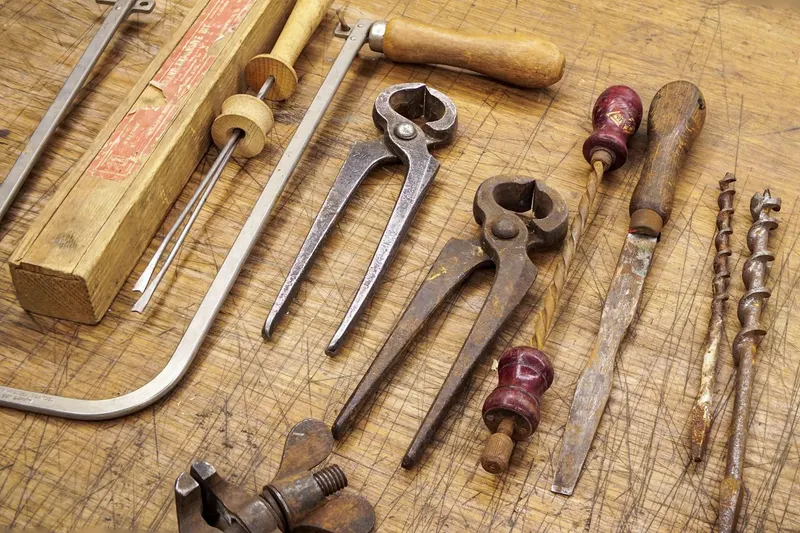
Ask most people to picture technology and they will describe a recent electronic device. That association is a handicap for anyone trying to understand the past, because it hides most of the story. For tens of thousands of years, human societies solved problems of food, shelter, transport, and communication with chipped stone, plant fibers, fire, clay, and later metals, without a single circuit. Before telling the history of any particular invention, a writer has to decide what the word covers, and that decision determines which stories get told at all.
How it works: the layers of a concept
The word comes from the Greek tekhne (craft, art, skill) and logos (discourse, study). Literally, "technology" would be the study of techniques, and that is how the term was used for a long time. In current usage it usually refers to the techniques and artifacts themselves.
Scholars often separate at least four layers:
- Technique: a way of doing something, such as shaping a pot or weaving a net. A technique can exist only as a learned gesture, with no object surviving.
- Knowledge: the understanding that guides the technique, from rules of thumb passed along in workshops to formal scientific theory.
- Artifact: the object made or used, such as an ax, a mill, or a telephone.
- System: the arrangement of artifacts, people, institutions, rules, and resources that makes everything work, such as an electric grid with power plants, companies, standards, and customers.
No layer is enough on its own. A tool found at an excavation says little if nobody knows who made it, from what material, and for what purpose. For that reason the history of technology overlaps with economic history, anthropology, archaeology, and sociology.
Invention, innovation, and diffusion
Three words appear constantly in the field, and it helps to keep them apart. Invention is the creation of a new device or method, whether as an idea, a drawing, or a prototype. Innovation is the point at which it enters real use in production, trade, or daily life. Diffusion is the process by which it spreads among groups, regions, and sectors, often changing along the way. The distinction between invention and innovation is commonly traced to the economist Joseph Schumpeter, writing in the first half of the twentieth century, and it is now standard.
This vocabulary prevents several confusions. A patent records a legal claim, not proof that a device worked. A public demonstration shows that something is possible, not that it is practical at scale. Many inventions waited years or centuries for an innovation stage, and many innovations depended on improvements by people other than the original inventor. The articles in this archive try to place each milestone in one of these stages when the evidence allows it.
Historical context: two ways of explaining technical change
One of the field's longest-running debates sets two families of explanation against each other. Technological determinism, in its stronger forms, holds that technology follows a logic of its own and pushes society in a particular direction: a new form of transport or communication, for example, would inevitably reorganize the economy and social life. Social construction of technology, associated with Trevor Pinch and Wiebe Bijker, argues that different social groups attach different meanings to the same artifact and that the final form depends on those contests. Their best-known case, presented in a 1984 article in the journal Social Studies of Science, is the nineteenth-century bicycle, where the high-wheeled model and the equal-wheeled "safety" model appealed to different groups of riders and were judged by different standards.
Most historians today work somewhere in between, accepting that physical and material constraints are real and that human choices matter too. The practical advice is to be suspicious of accounts in which one invention "changes everything" by itself, and equally of accounts in which a device is only a mirror of someone's interests.
Sociotechnical systems
The historian Thomas P. Hughes, in Networks of Power (1983), studied electrification in the United States, Britain, and Germany and showed that a successful electric network depended on far more than generators. It required companies, engineers, financiers, rate structures, laws, and habits of consumption. Hughes helped popularize the idea of a sociotechnical system, in which physical components and social components shape each other. He also pointed out that Thomas Edison worked less as a solitary inventor than as the organizer of a system, surrounded by laboratory staff and backed by investors. For readers, the lesson is to look at infrastructure as well as objects. The story of the telephone or of electricity in daily life is also a story of cables, exchanges, standards, and services.
How historians study the technical past
Each period demands different methods, and the available sources vary enormously.
- Archaeology. For eras without writing, artifacts and workshop debris are the main evidence. Radiocarbon dating, tree-ring dating, and residue analysis help establish chronologies.
- Experimental reconstruction. Researchers try to reproduce an ancient technique with the materials and tools available at the time. This tests whether a process is plausible and exposes difficulties that texts never mention, such as how long it takes to knap a stone point.
- Archives and documents. Contracts, letters, inventories, workshop notebooks, company reports, and technical treatises show who produced what, at what price, and for whom.
- Patents. Patent systems in recognizable form go back at least to the Venetian statute of 1474, which offered ten years of protection for new and useful devices, and the English Statute of Monopolies of 1624, which limited patents of invention to fourteen years for the first inventor of a new manufacture. The records show what was considered new and who claimed priority, but they do not capture everything that was actually made, and many practical improvements were never patented.
- Museums and collections. Preserved objects can be examined closely and compared, and many museums now publish open catalogs online.
- Oral history. For the twentieth century, interviews with workers, technicians, and users capture practical knowledge that was rarely written down.
Impact and limitations: what the evidence hides
None of these sources is neutral. The first limit is survival bias. Stone, fired clay, and metal last far longer than wood, fiber, leather, and paper, so the prehistoric past looks more "stone-based" than it was. Written records favor those who could write and whose writing was kept, usually men in elite positions, while the knowledge of women artisans, peasants, and peoples without writing survives in fragments.
The second limit is uneven attention. Some regions have been excavated and studied far more than others, which can create the impression that certain inventions arose only where research is densest. The third is the habit of telling history through the lone inventor. Most technologies come from accumulated contributions, near-simultaneous inventions, and priority disputes. In many cases there is no single point of origin to name, and when specialists disagree about dates and attributions, it is more honest to say so than to pick a side.
A related caution concerns the word "progress." Technical change has brought gains and costs, often falling on different people. A new machine can raise output and destroy a trade in the same decade. Good history tries to ask who benefited, who bore the costs, and who is missing from the record.
Connections to other technologies
The articles in this archive follow an approximately chronological order. They begin with the first tools, pass through metallurgy, writing, and the steam engine, and arrive at the modern factory and computational intelligence. Each one tries to describe the problem that existed before the innovation, how the solution worked, who took part, what its effects and limits were, and which institutional sources readers can consult to go further. Precise dates appear only where the evidence supports them; elsewhere the text uses "c." (circa, meaning about) or describes the debate.